








For more than a decade, the dominant narrative surrounding the future of urban transportation was centered on a single, glamorous vision: fleets of fully autonomous passenger cars sweeping through metropolitan centers, eliminating traffic jams and rendering personal vehicle ownership obsolete. Billions of dollars in venture capital and corporate research flowed into driverless software, high-definition radar arrays, and vehicle-to-everything communications.
Yet, as major cities grapple with the daily realities of congestion, climate mandates, and aging infrastructure, the most profound transportation revolution of the 21st century is occurring at a much smaller scale.
It is not taking place in four-ton autonomous robotaxis, but on two wheels and lightweight frames.
Driven by rapid advancements in micro-electronics, solid-state battery chemistry, edge artificial intelligence, and urban spatial planning, micro-mobility—encompassing electric bicycles, smart e-scooters, heavy-duty cargo tricycles, and modular light electric vehicles—has quietly emerged as the primary catalyst reshaping urban transit. Far from being a fleeting novelty or a recreational luxury, these lightweight, connected devices are solving structural urban problems that multi-ton passenger vehicles, whether autonomous or electric, simply cannot address.
The Silicon Shift in Lightweight Transport: IoT, Edge AI, and Cellular Telemetry
The early days of shared micro-mobility were defined by mechanical fragility and operational chaos. A decade ago, lightweight kick-scooters and basic pedal-assist bicycles were deployed onto city streets with minimal connectivity, leading to rapid hardware degradation, rampant vandalism, and sidewalk clutter that infuriated pedestrians and city council members alike.
Modern micro-mobility platforms bear little resemblance to those early iterations. Today, an e-bike or shared scooter is a sophisticated Internet of Things (IoT) edge computing endpoint, packed with sensor density that rivals modern automotive hardware.
Embedded within modern light electric vehicle frames are high-precision GNSS location modules, multi-axis accelerometers, cellular telematics units operating on low-power 4G and 5G networks, and specialized microcontrollers executing real-time diagnostics. Over-the-air (OTA) software updates continuously refine motor torque curves, balance battery cell discharge rates, and recalibrate anti-lock braking systems (ABS) based on localized pavement conditions.
+--------------------------------------------------------------------------+
|                     THE SENSOR ARCHITECTURE OF A MODERN E-VEHICLE        |
|                                                                          |
|  Handlebar / Frame Camera  ---> Edge AI Computer Vision (Sidewalk detect) |
|  Precision GNSS / GPS      ---> Sub-meter Geofencing (Speed/Parking lock) |
|  Multi-Axis Accelerometer  ---> Crash Detection & Vandalism Alerts       |
|  BMS & Telematics Module   ---> Real-time Battery Health & OTA Updates   |
+--------------------------------------------------------------------------+
The integration of low-power edge computer vision represents a major technological leap. Compact, weather-resistant camera modules mounted on handlebars or integrated directly into steering stems process video feeds locally using lightweight neural networks. These systems can distinguish between asphalt roadways, dedicated cycle tracks, and pedestrian sidewalks in real time.
If a rider mounts a sidewalk in a densely populated zone, the vehicle’s onboard controller detects the surface change and gently throttles power output, issuing an audible warning or enforcing compliance without relying on delayed cloud communication.
High-precision geofencing has similarly transformed municipal control. City transit planners can draw virtual boundaries around school zones, pedestrian plazas, or high-density transit hubs. When a micro-mobility device enters these zones, its speed is automatically capped to mandated limits, or its motor is disabled entirely if the area is designated as a no-ride zone. Dynamic parking verification algorithms require users to snapshot their parked vehicle, using machine learning to verify that the unit is safely docked within a designated bay before terminating the billing session.
Energy Architecture: Swappable Batteries and Solid-State Breakthroughs
The operational bottleneck of early electric micro-mobility was fleet maintenance and range management. Under legacy operating models, logistics teams spent millions of dollars operating diesel vans to collect depleted scooters and bikes, transport them to central warehouses for overnight charging, and redistribute them across city grids before morning rush hour. This practice eroded profit margins and introduced substantial carbon emissions into what was marketed as a green transit alternative.
The widespread adoption of modular, swappable battery architectures fundamentally changed the unit economics of lightweight electric transit.
Rather than hauling entire vehicles to charging warehouses, field technicians now navigate city centers on utility cargo bikes, swapping depleted battery packs for fresh ones in under 30 seconds. This decentralized re-fueling model increases vehicle uptime, extends fleet availability, and slashes operational overhead.
Concurrently, municipal energy grids are integrating public battery-swapping kiosks directly into urban streetscapes. These automated storage cabinets—integrated into streetlights, bus shelters, and parking meters—allow both gig-economy delivery workers and private commuters to exchange empty battery modules for fully charged units on demand, eliminating range anxiety entirely.
+--------------------------------------------------------------------------+
|                       BATTERY TECH PERFORMANCE EVOLUTION                 |
|                                                                          |
|  Standard Liquid Lithium-Ion  ---> 220 - 260 Wh/kg  (Standard Range)     |
|  Silicon-Anode Composites     ---> 300 - 350 Wh/kg  (+30% Range Boost)    |
|  Solid-State Modules (Target) ---> 400 - 450 Wh/kg  (2x Range / Fast Charge)|
+--------------------------------------------------------------------------+
At the cell level, advancements in battery chemistry are expanding vehicle capabilities. The introduction of silicon-carbon composite anodes and semi-solid-state electrolytes into commercial e-bike batteries has increased energy density while improving thermal stability and cold-weather performance.
These higher-density cells allow manufacturers to build sleek, lightweight frames with batteries fully concealed inside the down-tube, delivering ranges of 60 to 80 miles on a single charge. Combined with ultra-fast charging protocols capable of replenishing 80 percent capacity in 20 minutes, energy constraints are no longer a barrier to daily micro-mobility commuting.
The Freight Revolution: How Cargo E-Bikes Are Decarbonizing Commercial Logistics
While passenger transport garners significant media coverage, the most disruptive shift in urban micro-mobility is occurring in commercial freight and last-mile logistics.
Global e-commerce growth has flooded city streets with delivery vans, leading to severe double-parking congestion, elevated urban emissions, and millions of dollars in municipal parking fines absorbed by logistics conglomerates as a routine cost of doing business. In dense urban cores like London, Paris, New York, and Tokyo, heavy delivery trucks travel at average speeds below six miles per hour during peak hours, idling in traffic while idling fuel and burning money.
Commercial cargo e-bikes and heavy-duty electric utility tricycles have emerged as a far more efficient alternative for urban parcel distribution.
+--------------------------------------------------------------------------+
|                     LAST-MILE FREIGHT EFFICIENCY MATRIX                  |
|                                                                          |
|  Commercial Delivery Van   ---> High Curb Usage  ---> 6-8 mph Avg Speed   |
|  Heavy Utility Cargo Bike  ---> Zero Curb Block   ---> 12-15 mph Avg Speed |
|  Micro-Hub Logistics       ---> Local Sourcing   ---> 80% Emission Cut   |
+--------------------------------------------------------------------------+
Equipped with high-torque mid-drive motors, heavy-duty hydraulic disc brakes, differential axles, and articulate trailers, modern cargo e-bikes can carry payloads between 300 and 800 pounds while effortlessly navigating dedicated bicycle lanes and narrow historic alleys.
Logistics leaders like DHL, UPS, and Amazon have restructured their urban distribution networks around a “micro-hub” model. Long-haul tractor-trailers or electric trucks deliver bulk cargo to small, localized consolidation hubs situated in underground parking garages, repurposed shipping containers, or neighborhood storefronts. From these micro-hubs, couriers on cargo bikes disperse parcels across surrounding neighborhoods.
Logistics field data demonstrates that in dense metropolitan centers, cargo bikes complete parcel deliveries up to 60 percent faster than conventional vans. Because bike couriers can park directly on wide footpaths or designated loading bays without blocking traffic lanes, they spend less time searching for parking and walking back and forth to delivery destinations. Furthermore, replacing a diesel delivery van with an electric cargo bike eliminates thousands of pounds of carbon emissions annually while drastically lowering municipal infrastructure wear and tear.
Mobility-as-a-Service (MaaS) and Public Transit Integration
For decades, public transit systems operated as rigid, fixed-route networks. Heavy rail and bus lines were exceptionally efficient at moving thousands of people along high-density arteries, but struggled with the “first-mile/last-mile” problem—the geographic gap between a commuter’s front door and the nearest transit station.
This access gap historically forced city residents to rely on personal automobiles or ride-hailing services, fueling traffic congestion and filling suburban transit station parking lots to capacity.
Micro-mobility technology has bridged this gap, transforming isolated public transit networks into fluid, multimodal transportation systems through Mobility-as-a-Service (MaaS) software integration.
Modern city transit apps allow commuters to plan, book, and pay for multi-stage journeys across disparate transportation modes using a single digital interface or contactless transit card. A commuter can unlock a shared e-scooter outside their apartment, ride four blocks to the local metro station, board an express train downtown, and switch to an integrated docked e-bike for the final five-minute leg to their office building—all managed under a single, unified fare cap.
COMMUTER FIRST-MILE / LAST-MILE JOURNEY

Suburban Home
  │
  ├── [Micro-Mobility] ---> E-Scooter / Bike Share (First-Mile)
  ▼
Metro / Bus Terminal
  │
  ├── [Mass Transit]   ---> High-Speed Heavy Rail / Express Bus
  ▼
Downtown Core
  │
  ├── [Micro-Mobility] ---> Cargo E-Bike / Shared Fleet (Last-Mile)
  ▼
Final Destination / Office
Transit agencies are actively subsidizing micro-mobility access for residents living in transportation deserts—low-income or low-density neighborhoods poorly served by traditional bus routes. By co-locating charging docks and shared fleet hubs at rail terminals and bus stops, cities effectively expand the geographic catchment area of every transit station from a 10-minute walking radius (roughly half a mile) to a 10-minute riding radius (over two miles).
This spatial expansion allows transit authorities to increase rider throughput without undertaking the multi-billion-dollar capital expenditure required to lay new rail track or expand bus fleets into low-density suburbs.
Regulatory Maturation and Spatial Infrastructure Realities
The rapid expansion of lightweight transportation has forced a fundamental redesign of municipal regulation and urban spatial engineering. The early era of regulatory ambiguity—where operators dropped thousands of dockless vehicles onto streets overnight without local permits—has given way to structured, long-term municipal partnerships.
City governments now manage micro-mobility through dynamic permitting frameworks that balance public access with order and safety:
- Fleet Cap Management: Municipalities issue competitive tenders to a limited number of operators, tying allowable fleet sizes directly to performance metrics such as vehicle uptime, parking compliance rates, and equitable geographic distribution across lower-income districts.
- Data Sharing Specifications: Operators are mandated to share anonymized, high-resolution trip data with city planning departments using standardized protocols like the Mobility Data Specification (MDS) and General Bikeshare Feed Specification (GBFS). Planners analyze these data streams to map popular travel corridors, identify hazardous intersections, and determine exactly where new protected bicycle infrastructure is needed most.
- Mandatory Safety and Hardware Certifications: To address early concerns regarding battery fires and structural failures, cities increasingly require all shared and personal micro-mobility devices to pass strict hardware safety standards, including Electrical System Safety Certifications (such as UL 2272 and UL 2849).
+--------------------------------------------------------------------------+
|                   EVOLUTION OF URBAN MICRO-MOBILITY POLICY               |
|                                                                          |
|  2016-2019: The "Wild West" Era  ---> Unregulated dockless deployments   |
|  2020-2023: Permitting & Caps    ---> Speed limits, local operator licenses|
|  2024-2026: Infrastructure Era   ---> Protected lanes, MaaS, UL standards|
+--------------------------------------------------------------------------+
The most lasting impact of micro-mobility tech is the physical transformation of the streetscape itself. City planners increasingly recognize that lightweight electric vehicles cannot safely coexist with either high-speed motor traffic or foot-bound pedestrians.
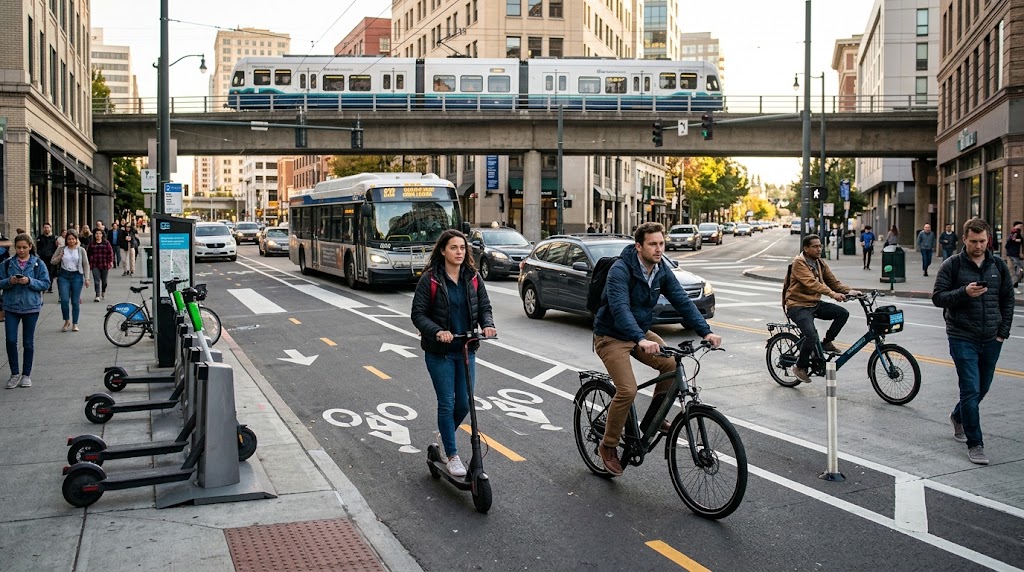
As a result, major urban centers are reallocating physical road space away from private automobiles and toward protected micro-mobility infrastructure. Multi-lane avenues in Paris, Bogota, New York, and Amsterdam are being systematically redesigned with widened, physically separated bike highways capable of accommodating high-volume traffic moving at varying speeds—from traditional analog bicycles traveling at 10 mph to heavy cargo tricycles and high-speed commuter e-bikes cruising at 20 mph.
By reclaiming curb space historically reserved for idle, parked cars and converting it into micro-mobility charging stations, green space, and widened sidewalks, cities are actively altering their spatial priorities.
The Efficiency Math: Why Light Transportation Wins
To understand why micro-mobility technology is outstripping larger transportation innovations in urban adoption, one must look at the fundamental physics and spatial economics of personal transit.
The modern passenger car is a masterclass in mechanical over-engineering for single-occupant urban trips. The average private vehicle weighs between 3,500 and 6,000 pounds, occupies over 100 square feet of scarce urban real estate, and sits parked and unused for 95 percent of its operational life. When a single commuter uses a three-ton electric SUV to travel two miles to buy a loaf of bread, more than 99 percent of the energy expended during that journey goes toward moving the massive steel, glass, and battery chassis itself—leaving less than one percent of the energy to transport the human passenger.
Micro-mobility reverses this staggering energy inefficiency:
- Energy Ratio: A modern electric bicycle weighs between 30 and 50 pounds, using less than two percent of the electrical energy required to move an electric passenger car over the same distance.
- Spatial Footprint: Up to ten bicycles or e-scooters can comfortably park in the physical space required for a single full-sized pickup truck or SUV.
- Infrastructure Impact: Lightweight vehicles exert virtually zero wear and tear on road surfaces compared to heavy multi-ton automobiles, drastically reducing municipal street maintenance and repair budgets.
ENERGY EXPENDITURE COMPARISON (SINGLE-PASSENGER 3-MILE TRIP)

Electric SUV (4,500 lbs)
[==================================================] ~1,000 Wh Energy Used

Electric Cargo Bike / E-Bike (50 lbs)
[==] ~20-30 Wh Energy Used
Even as passenger cars transition from internal combustion engines to electric powertrains, electrification alone does not solve urban traffic gridlock or spatial scarcity. Replacing one million gasoline cars idling in city traffic with one million electric cars simply creates an electrified traffic jam.
Micro-mobility technology offers an entirely different urban model: one that scales down the physical tool to fit the actual dimensions and energy demands of the human task.
The Future of Human-Centric Cities
The debate over the future of urban mobility has long been dominated by futuristic promises of autonomous flying taxis and subterranean automobile tunnels. Yet the most effective, scalable, and equitable solution to urban transport has proven to be far simpler, lighter, and more immediate.
Micro-mobility technology is not merely supplementing existing public transit networks; it is redefining the relationship between citizens and urban space. By combining advanced sensor telematics, high-density energy storage, intelligent logistics architecture, and human-centric infrastructure design, cities are dismantling their long-standing reliance on single-occupant passenger vehicles.
As governments face compounding pressures from global climate mandates, urban population growth, and public health priorities, the quiet revolution occurring on two wheels has become impossible to ignore. The future of metropolitan transit will not be defined by how fast we can move multi-ton machines through crowded city streets, but by how intelligently we can liberate urban space for people.