









For nearly three decades, the digital revolution in personal living spaces was defined by the relentless addition of black rectangles. Smartphones occupied hands, tablets sat on coffee tables, monitors dominated home offices, and increasingly massive television screens anchored living room walls. As microprocessors became faster and displays grew sharper, the home environment gradually adapted to the physical demands of technology, forcing residents to organize their furniture, lighting, and daily habits around static, glowing pieces of glass.
In 2026, that visual clutter is reaching a quiet turning point. A fundamental shift in residential architecture, material science, and ambient artificial intelligence is giving rise to a new paradigm in human-computer interaction: the ambient home interface.
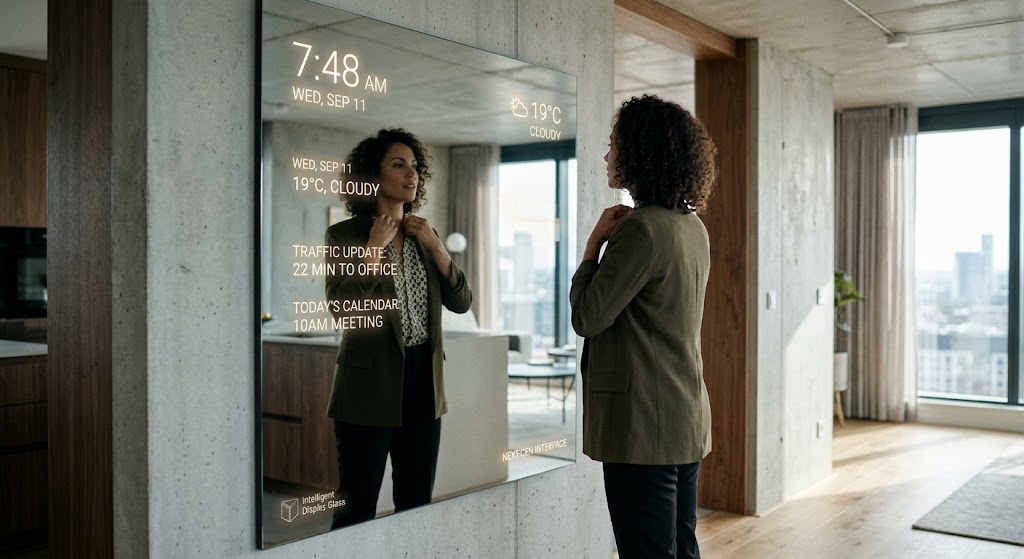
Rather than forcing users to pull out a phone or stare at a dedicated monitor, ambient computing embeds digital intelligence directly into the physical surfaces of the home. Leading this architectural transformation are smart mirrors and intelligent display glass—surfaces that function as ordinary mirrors, windows, shower enclosures, or kitchen backsplashes when idle, but instantly illuminate with contextual information, health analytics, and control interfaces when approached.
By rendering technology invisible until it is needed, intelligent display glass is dismantling the monopoly of the traditional screen. It represents a transition away from active, distracting digital devices and toward a calmer, more harmonious integration of technology within the physical sanctuary of the home.
The Death of the Black Rectangle: Why Screen Fatigue Is Driving Ambient Design
The migration toward transparent and mirror-embedded displays is born out of a growing cultural and ergonomic resistance to traditional screens. As remote work, digital entertainment, and smart home management expanded, the average individual spent upwards of eight to ten hours a day staring at emissive, opaque displays. Upon stepping away from work desks, users returned to living spaces dominated by large, dark television panels that disrupted interior aesthetics and served no aesthetic purpose when powered off.
This friction revived interest in “Calm Technology”—an engineering philosophy originally articulated by Xerox PARC researchers Mark Weiser and John Seely Brown in the late 1990s. Calm technology posits that the most profound technologies are those that disappear, weaving themselves into the fabric of everyday life until they are indistinguishable from it.
Intelligent display glass fulfills this vision by merging input, output, and architectural materials into a single element. When powered down, a smart mirror is indistinguishable from a high-grade silvered glass mirror; an intelligent display window remains a crystal-clear pane offering an unobstructed view of a garden or city skyline.
When activated by presence sensors or soft voice commands, these surfaces shift instantly, bringing unobtrusive, high-contrast digital information into the user’s natural line of sight. By eliminating the need for dedicated, standalone monitors, ambient interfaces restore physical space to the home while providing immediate access to digital utilities.
The Mirror as the Primary Ambient Node
The bathroom vanity mirror was the natural starting point for this ambient revolution. Unlike smartphones or laptops, which require intentional retrieval and active focus, a mirror is an architectural constant. Human beings naturally stand before a mirror multiple times a day during established routines—brushing teeth, shaving, applying skincare products, or dressing.
Early iterations of smart mirrors were simple novelties: basic LCD panels retrofitted behind two-way mirror glass to display weather widgets, clock faces, and news RSS feeds. Modern smart mirrors, however, have evolved into sophisticated biometric and diagnostic nodes powered by localized machine learning models.
+--------------------------------------------------------------------------+
|                     SMART MIRROR DOMAINS & CAPABILITIES                  |
|                                                                          |
|  Bathroom & Health Nodes   ---> AI Skin Diagnostics & Vital Telemetry    |
|  Fitness & Motion Surfaces ---> 3D Computer Vision & Live Form Coaching   |
|  Retail & Vanity Systems   ---> Multi-Spectrum Lighting & Virtual Try-On  |
+--------------------------------------------------------------------------+
1. Health and Skincare Diagnostics
Modern bathroom smart mirrors utilize multi-spectrum lighting arrays and high-resolution optical sensors to conduct non-invasive health checks during morning routines. By analyzing facial vascular patterns through photoplethysmography (PPG), advanced mirror systems can estimate heart rate, blood oxygen levels, and relative stress markers without requiring wearable hardware.
In skincare and dermatology, integrated AI models capture high-definition imagery under controlled color-rendering index (CRI) illumination. The mirror tracks subtle changes in hydration levels, inflammation, skin texture, and UV damage over weeks and months, offering personalized product recommendations or flagging suspicious skin anomalies for medical evaluation.
2. Camera-Aware Fitness Coaching
In personal wellness and fitness spaces, smart mirrors have transitioned from passive video players into interactive movement surfaces. Utilizing high-frame-rate time-of-flight (ToF) sensors and 3D spatial vision algorithms, fitness mirrors analyze user biomechanics during strength training, yoga, or physical rehabilitation exercises.
Rather than requiring a user to turn their head toward a side monitor during a workout, the mirror reflects their physical body while superimposing real-time skeletal tracking lines directly over their image. If a user’s form degrades during a squat or deadlift, the system highlights joint misalignment directly on the glass, providing instant, injury-preventing feedback.
3. Precision Lighting and Vanity Control
For grooming and makeup application, intelligent mirrors prioritize advanced photometric controls over complex digital widgets. High-grade systems offer continuous Color Rendering Index (CRI) ratings above 95, alongside adjustable Correlated Color Temperature (CCT) sliders ranging from 2,700 Kelvin (warm indoor tungsten) to 6,500 Kelvin (cool midday sunlight). This allows users to test how cosmetic application or apparel choices will appear across varying real-world lighting environments before leaving the house.
The Material Physics: Transparent Micro-LEDs and Smart Glass Layers
Moving from a reflective mirror surface to fully transparent, interactive display glass across windows, doors, and room dividers required fundamental breakthroughs in semiconductor physics, substrate engineering, and optical coatings.
Traditional Liquid Crystal Displays (LCDs) rely on bright backlights passing through polarizers and liquid crystal layers, making complete transparency physically impossible. Early transparent Organic Light-Emitting Diode (T-OLED) displays offered a leap forward, achieving transparency levels near 40 percent by placing self-emissive sub-pixels on clear matrix substrates. However, transparent OLEDs suffered from limited peak brightness and burn-in risks when exposed to direct sunlight.
The commercialization of Transparent Micro-LED technology has removed these physical barriers:
- Ultra-High Transparency: Micro-LED display structures utilize microscopic light-emitting diodes measured in micrometers—smaller than a grain of fine sand. Because these microscopic emitters occupy a tiny fraction of the glass substrate’s total surface area, the remaining space remains entirely clear, driving visual transparency beyond 70 to 80 percent.
- Extreme Peak Brightness: Micro-LEDs deliver thousands of nits of peak brightness, allowing digital graphics, text, and video overlays to remain crisp and readable even when direct sunlight streams through a living room window.
- Electrochromic Privacy Layers: Modern intelligent glass layers stack transparent Micro-LED matrices alongside Polymer Dispersed Liquid Crystal (PDLC) or electrochromic films. By applying a tiny electrical voltage, the glass can transition within milliseconds from crystal-clear transparency to a milky translucent privacy barrier, or darken to an opaque shade to maximize display contrast for movie viewing.
+--------------------------------------------------------------------------+
|                     INTELLIGENT GLASS LAYER ARCHITECTURE                 |
|                                                                          |
|  Outer Protective Glass  ---> Scratch-Resistant & Anti-Reflective Coating|
|  Micro-LED Matrix Layer  ---> Self-Emissive Transparent Display Grid     |
|  PDLC Electrochromic Film---> Voltage-Controlled Opacity / Privacy Layer |
|  Integrated Touch/Sensor ---> Optical / Capacitive / mmWave Radar Layer  |
|  Inner Substrate Glass   ---> Hydrophobic / Structural Safety Glass     |
+--------------------------------------------------------------------------+
Simultaneously, traditional physical touchscreens—which leave unsightly fingerprint smudges on glass surfaces—are being augmented by touchless spatial control. Microscopic millimeter-wave (mmWave) radar modules and optical time-of-flight sensors embedded behind the glass perimeter track hand gestures, finger proximity, and body orientation in three dimensions. Users can wave to dim a window’s tint, pinch the air to adjust room temperature, or point to expand a morning schedule without ever touching the glass itself.
Contextual Intelligence: The Software Layer of Ambient Surfaces
A transparent screen that continuously displays bright notifications, social media updates, and flashing alerts would quickly turn a calm home environment into an exhausting visual nightmare. The success of ambient interfaces relies entirely on context-aware software architectures that practice aggressive information restraint.
Modern ambient glass interfaces are powered by lightweight, localized artificial intelligence models integrated with unified smart home connectivity protocols, such as Matter and Thread. Rather than serving as a passive monitor that requires manual navigation through nested menus, the display surface operates on presence, intent, and daily rhythm.
THE AMBIENT INTERACTION CONTINUUM

[ Passive State ]    ---> Fully Transparent / Reflective Glass (Zero Distraction)
        │
        ▼  (Approach Detected via mmWave Radar)
[ Ambient State ]    ---> Subtle Peripheral Information (Time, Temperature, Schedule)
        │
        ▼  (Direct Gaze / Voice / Gesture Detected)
[ Interactive State] ---> Active Diagnostic, Control, or Media Interface
Consider the natural progression of a morning routine enabled by intelligent display glass:
- Passive Architectural State: As a resident walks into the kitchen, the window above the sink appears as ordinary clear glass, offering an unobstructed view outside.
- Peripheral Ambient State: As the resident approaches the counter to prepare coffee, presence sensors trigger a subtle, low-contrast overlay in the lower corner of the windowpane, displaying the current outdoor temperature, a localized rain forecast, and a brief summary of the morning transit schedule.
- Active Interactive State: If the resident asks a question or gestures toward the glass, the interface expands smoothly to display a full step-by-step recipe or stream a news briefing.
- Dissolution State: As soon as the user steps away from the counter, the digital information fades gracefully within seconds, returning the window pane to a clean, transparent glass surface.
By tying display behavior to human proximity and intent, ambient interfaces prevent digital fatigue. Information is delivered at the exact moment and physical location where it is actionable, disappearing completely when the task is complete.
Privacy at the Edge: Securing the Domestic Sanctuary
Installing optical cameras, microphone arrays, and continuous physiological sensors on surfaces in intimate residential spaces—such as bathrooms, bedrooms, and private dressing quarters—presents severe privacy risks. A data breach involving a living room television is frustrating; a compromise of an internet-connected bathroom mirror is a catastrophic violation of personal privacy.
To overcome these adoption barriers, hardware architects and software developers have implemented strict “Privacy by Design” security models at both the hardware and firmware levels.
Localized On-Device Edge Processing
Modern smart mirrors and intelligent display panels do not stream raw video or audio data to external cloud servers for processing. Computer vision tasks—such as tracking exercise form, analyzing skin conditions, or recognizing user gestures—are executed entirely on local Neural Processing Units (NPUs) built directly into the display frame.
Raw camera frames are processed in volatile memory (RAM) and immediately discarded within milliseconds. Only anonymized, mathematical coordinate vectors leave the processing enclave, ensuring that recognizable visual imagery never touches a hard drive or leaves the physical boundary of the home.
Non-Optical Sensing Alternatives
To eliminate privacy concerns entirely in wet rooms and private suites, manufacturers are increasingly replacing traditional optical RGB cameras with non-visual sensor alternatives.
Millimeter-wave (mmWave) radar and thermal sensors can accurately track human movement, fall events, breathing rates, and exercise posture by analyzing reflected radio waves or heat signatures. These non-optical systems provide complete spatial awareness and health tracking while making it physically impossible to capture recognizable visual images of household residents.
Physical and Electromechanical Shutters
For devices that include optical camera modules for beauty analysis or video communications, hardware makers are incorporating physical, mechanical privacy shutters. Controlled by physical switches or electromechanical relays that emit an audible click, these shutters physically block optical lenses when not actively in use, offering users an undeniable visual guarantee of privacy.
Environmental Architecture: Dynamic Glazing and Energy Efficiency
Beyond delivering personal information and ambient control interfaces, intelligent display glass plays a direct role in sustainable home architecture and building energy management.
Windows are historically the most thermally inefficient components of a building envelope, accounting for a significant percentage of residential heating and cooling energy loss. By integrating electrochromic smart glass coatings with ambient environmental sensors, intelligent windows serve as active, climate-responsive thermal barriers.
During hot summer months, onboard light sensors measure solar radiation and internal ambient temperatures. The window glass automatically adjusts its tint level in real time, reflecting infrared solar heat while allowing comfortable levels of visible natural light to enter. This dynamic solar control reduces a home’s air conditioning load dramatically without requiring residents to draw physical blinds or live in dark rooms.
In winter conditions, the process reverses: the glass remains fully transparent during sunny hours to maximize passive solar heating, then transitions to an insulated, low-emissivity state at sunset to lock interior heat inside.
When linked with smart home HVAC platforms via unified standards like Matter, intelligent glass coordinates with heat pumps, smart thermostats, and motorized shades to optimize building energy performance automatically, turning static building facades into active climate regulation networks.
The Path to Ubiquity: Cost, Durability, and Installation Standards
Despite rapid technological maturation and high consumer interest, the transition from conventional glass to intelligent display surfaces faces real installation and economic bottlenecks before achieving mass-market saturation.
The primary obstacle remains initial capital costs. High-performance transparent Micro-LED glass and custom smart vanity mirrors currently carry a significant price premium over standard architectural glass and LCD displays. Manufacturing large, defect-free sheets of transparent display glass requires specialized cleanroom facilities, advanced bonding equipment, and high-purity materials, keeping current installations concentrated in luxury residential developments, high-end hospitality projects, and executive commercial real estate.
Installation complexity presents a parallel challenge. Installing an intelligent display window or built-in bathroom smart mirror is not a simple consumer plug-and-play process. It requires coordination across multiple traditional building trades:
- Glaziers and Structural Contractors: Must handle heavy, custom-cut safety glass and ensure watertight seals within building facades or wet-room environments.
- Electricians and System Integrators: Must route low-voltage DC power lines and high-speed data buses through hidden wall channels, door hinges, and window frames without compromising structural integrity or aesthetic lines.
- Serviceability Considerations: Unlike a traditional smartphone or television that can be easily unplugged and taken to a service center when a component fails, replacing an embedded circuit board inside a custom-installed kitchen backsplash or double-paned exterior window pane is a complex, costly operation. Manufacturers are forced to design modular, externally accessible control pods mounted in adjacent cabinetry or service hatches to ensure long-term repairability.
As manufacturing yields for transparent Micro-LEDs improve and standardized low-voltage wiring protocols become commonplace in modern residential construction, these installation costs will decline, following the same price-drop curve that transformed flat-panel televisions from luxury novelties into universal home utilities.
Reclaiming the Domestic Sanctuary
The ultimate significance of the shift from smart mirrors to intelligent display glass extends far beyond tech industry feature lists or novel home automation tricks. It represents a long-overdue recalibration of humanity’s relationship with the digital world.
For the first twenty-five years of the internet age, technology demanded that human beings adapt to its physical constraints. We bent our posture over laptops, strained our necks over handheld screens, and allowed glowing black boxes to dominate our living rooms, bedrooms, and social spaces.
Ambient interfaces reverse that balance. By embedding computing power into the timeless, natural architecture of the home—into the mirrors we look through to start our day, the windows that connect us to the outdoors, and the glass partitions that structure our living spaces—technology recedes back into the background.
The future of the smart home is not a space filled with more screens, louder notifications, and constant digital demands for human attention. It is a home that remains quiet, open, and beautiful—a sanctuary where digital intelligence serves us silently from the very glass that surrounds us, appearing when needed, and vanishing the moment we turn back to live our lives.