









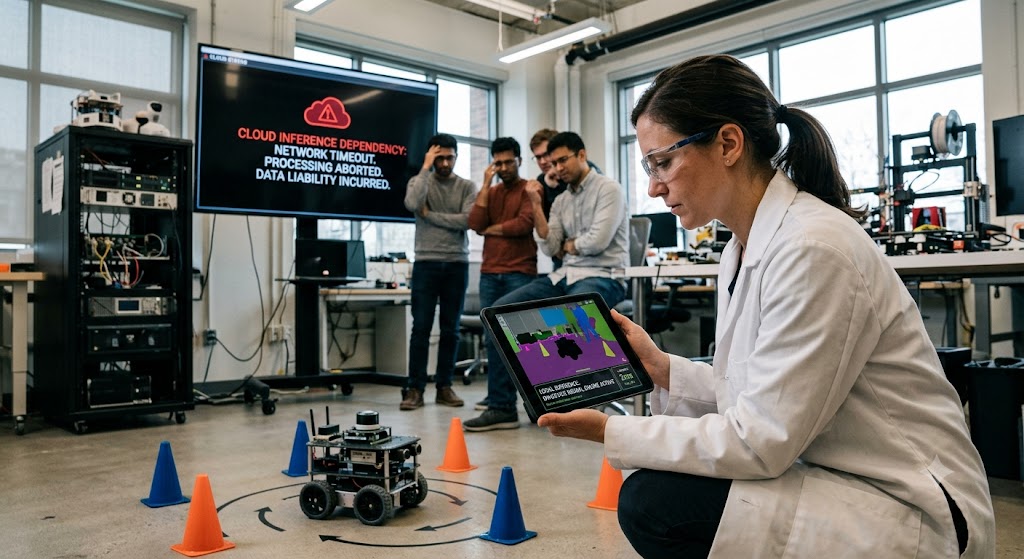
For the first decade of the modern artificial intelligence boom, the strategic consensus across the technology sector was simple and centralized: shift everything to the cloud. As deep learning models ballooned from millions to hundreds of billions of parameters, tech giants built sprawling data centers packed with high-power graphics processing units (GPUs). Everyday devices—from smartphones and laptops to industrial sensors and automobiles—served largely as thin clients, capturing raw user inputs and beaming them across global fiber-optic networks to distant server farms for processing.
That centralized architecture is now confronting its physical, financial, and structural limits.
In 2026, the tech industry is undergoing a decisive shift toward edge computing. Driven by the saturation of dedicated Neural Processing Units (NPUs) across modern consumer and enterprise silicon, artificial intelligence is migrating from remote server fortresses directly onto local hardware. What began as an experimental optimization for mobile photography has transformed into a fundamental architectural imperative.
As enterprise AI adoption scales, exclusive reliance on remote cloud infrastructure for real-time inference has turned from a competitive advantage into a severe operational liability. Companies that rely entirely on cloud-based AI face mounting bandwidth costs, unpredictable latency spikes, catastrophic network dependencies, and continuous regulatory exposure over data privacy.
The rise of on-device neural engines is redefining the baseline for personal computing, establishing local execution as a non-negotiable requirement for next-generation digital products.
The Latency Wall: Why Split-Second Decisions Demand Local Silicon
The most immediate operational friction point with cloud-dependent artificial intelligence is deterministic latency. In network engineering, latency is governed by immutable physical laws. Even at near the speed of light through fiber-optic cables, transmitting data from a client device to a cloud data center, queuing it for GPU processing, running model inference, and routing the response back takes anywhere from several hundred milliseconds to multiple seconds.
For routine administrative tasks—such as generating a long-form marketing draft or analyzing historical financial spreadsheets—a two-second round-trip network delay is imperceptible. For real-time physical and digital interactions, that same delay is fatal to user experience and operational safety.
Consider autonomous transport and advanced driver-assistance systems. A vehicle traveling at highway speeds covers dozens of meters every second. Computer vision algorithms processing live sensor feeds must detect obstacles, predict pedestrian trajectories, and trigger emergency braking within single-digit milliseconds. Waiting for a cloud server to process camera frames over a cellular connection introduces catastrophic risks of signal loss, packet drops, and network congestion.
Similar dynamics govern spatial computing, real-time voice translation, surgical robotics, and industrial quality control. In augmented reality headsets, any delay between a user’s head movement and the rendering of digital overlays triggers motion sickness and breaks visual immersion. In manufacturing plants, high-speed camera nodes inspecting thousands of components per minute must identify structural defects instantaneously to trigger mechanical sorting arms.
On-device neural engines eliminate network overhead entirely. By processing neural network matrix math directly on local silicon, response times drop from unpredictable hundreds of milliseconds down to guaranteed, sub-millisecond thresholds. When real-time reliability is non-negotiable, local execution is the only viable engineering path.
The Untenable Economics of Cloud Inference at Scale
Beyond the physics of network speed lies a brutal financial reality: the escalating cost of cloud compute.
During the initial experimental phase of generative artificial intelligence, software vendors willingly absorbed high cloud API charges to demonstrate new capabilities and acquire users. However, as millions of consumers and enterprise employees integrate AI assistants into their daily workflows, paying metered cloud fees for every keystroke, voice command, and image edit has created massive financial drag.
Running multi-billion-parameter models inside hyperscale data centers requires continuous, capital-intensive investments in server infrastructure, specialized cooling systems, and massive electrical power grid allocations. When an enterprise scales an AI-driven product to millions of daily active users, the cumulative API charges and cloud server bills can rapidly consume gross profit margins.
On-device neural engines fundamentally alter these unit economics through offloading compute to client-side hardware.
TRADITIONAL CLOUD INFERENCE vs. ON-DEVICE EXECUTION

Cloud-Centric Model
User Device  --->  Cellular / Fiber Network  --->  Hyperscale Data Center (Cloud GPUs)
                   [High Latency / High API Costs / Vulnerable to Network Outages]

On-Device Model (NPU Architecture)
User Device  --->  Local NPU / System-on-Chip Execution  ---> Instant Output
                   [Zero Network Latency / Zero API Costs / Full Offline Functionality]
By deploying compressed, highly optimized Small Language Models (SLMs) and specialized vision networks locally on a user’s laptop, smartphone, or edge gateway, software developers shift the computational burden onto hardware the customer already owns. Once a model is deployed to an on-device NPU, executing inference carries a marginal cost of zero dollars for the software provider.
This economic reality has driven rapid advancements in model compression techniques, such as activation-aware quantization (AWQ), pruning, and low-rank adaptation (LoRA). Developers can now shrink 3-billion to 7-billion parameter models down to a fraction of their original memory footprint, allowing them to run locally on consumer hardware without sacrificing functional accuracy. For software vendors, transitioning routine AI queries from the cloud to local NPUs is no longer just a technical upgrade; it is a financial survival strategy.
Privacy, Compliance, and the Zero-Trust Imperative
While cost and latency drive technical architecture, regulatory pressure and corporate security concerns have turned data privacy into a major catalyst for the edge AI revolution.
The traditional cloud AI paradigm requires users to surrender highly sensitive, unencrypted information to remote servers. Every voice recording, biometric scan, confidential medical report, proprietary source code file, and personal text prompt transmitted across the internet creates potential attack surfaces for network interception, server-side data breaches, and unauthorized corporate data harvesting.
Under modern global compliance frameworks—including the European Union’s General Data Protection Regulation (GDPR), the Health Insurance Portability and Accountability Act (HIPAA), and various regional data localization mandates—transmitting sensitive personal or institutional records across jurisdictional borders is a legal minefield. A single data breach involving centralized cloud databases can result in multi-million-dollar regulatory fines and catastrophic reputational damage.
On-device neural engines solve this compliance friction through privacy-by-design architecture:
- Local Data Isolation: Sensitive biometric data, personal photos, private documents, and voice recordings remain entirely contained within the physical boundaries of the local device. Raw data never touches a network cable or remote server.
- Minimization of Attack Surfaces: By eliminating continuous cloud data transmissions, organizations remove single points of corporate exposure, rendering data immune to broad cloud server breaches or mid-transit network interception.
- Operational Resilience Without Connectivity: Devices retain full AI capability in offline environments, ensuring that remote industrial sites, aircraft cabins, underground transit facilities, and medical clinics remain fully operational during wide-area network blackouts.
Furthermore, innovations such as federated learning allow machine learning models to improve over time without violating user privacy. Under federated frameworks, edge devices train local AI models using locally retained data, sharing only abstract mathematical weight updates back to a central server. The global model grows smarter while raw user records never leave the physical device.
The Silicon Transformation: Why CPUs and GPUs Need the NPU
The rapid transition to local AI processing has triggered an aggressive restructuring of semiconductor architecture. For decades, personal computing relied on two primary processors: the Central Processing Unit (CPU) for sequential system logic, and the Graphics Processing Unit (GPU) for parallel visual rendering.
While GPUs excel at heavy parallel computing tasks—making them ideal for training massive AI models inside data centers—they are structurally ill-suited for continuous, low-power AI inference on battery-powered mobile devices. GPUs draw substantial power, generate significant ambient heat, and quickly trigger thermal throttling inside thin smartphone frames and ultra-light laptops.
Enter the Neural Processing Unit (NPU).
An NPU is a specialized microprocessor engineered explicitly to accelerate the mathematical operations that underpin artificial intelligence—specifically low-precision matrix multiplication, convolution, and non-linear activation functions.
Unlike general-purpose processors, NPUs are designed to execute trillions of operations per second (TOPS) while drawing a tiny fraction of the electrical wattage required by standard CPUs or GPUs.
THE HETEROGENEOUS SILICON TRIAD

1. Central Processing Unit (CPU)
   - Primary Role: Sequential processing, operating system logic, general application tasks.
   - Design Focus: Low latency for single-threaded operations.

2. Graphics Processing Unit (GPU)
   - Primary Role: High-density parallel rendering, 3D graphics, heavy scientific compute.
   - Design Focus: Massive throughput at higher power consumption.

3. Neural Processing Unit (NPU)
   - Primary Role: Deep learning matrix math, real-time AI inference, vision and audio models.
   - Design Focus: Maximum TOPS (Trillions of Operations Per Second) per watt.
Major semiconductor designers have made dedicated NPUs standard across their primary hardware lines. Apple’s A-series and M-series chips feature high-performance Neural Engines capable of processing dozens of trillions of operations per second. Qualcomm’s Snapdragon platforms, Intel’s Core Ultra line, and AMD’s Ryzen AI processors all feature dedicated NPU blocks designed to meet strict operating system performance standards for local AI acceleration.
By offloading repetitive AI tasks—such as live audio noise cancellation, background video segmentation, continuous voice recognition, and real-time text summarization—from the CPU and GPU onto the specialized NPU, devices achieve smoother system performance, lower thermal output, and all-day battery life during continuous AI workloads.
The Emergence of the Hybrid Architecture
The aggressive expansion of on-device neural processing does not herald the complete death of hyperscale cloud computing. Rather, it marks the end of the cloud monopoly, establishing a sophisticated hybrid computing architecture that balances local edge autonomy with central cloud capacity.
In this emerging hybrid ecosystem, artificial intelligence workloads are dynamically routed based on task complexity, latency thresholds, and privacy requirements:
- The On-Device Tier (The Edge): The local NPU serves as the primary, immediate interaction layer. It executes lightweight local models (typically 1B to 7B parameters) to handle real-time voice translation, UI navigation, local text editing, image enhancement, biometric security, and sensor fusion natively on the device with zero latency and complete privacy.
- The Sovereign Fallback Tier (Private Cloud Compute): When a user initiates a complex, highly demanding query that exceeds the physical memory or parameter capacity of the local NPU, the task is escalated to specialized, privacy-hardened cloud clusters. These secure cloud environments execute inference in volatile memory, process the complex reasoning task, return the output, and immediately wipe all execution logs without retaining user records.
- The Hyperscale Core (Central Cloud): Massive centralized data centers remain unmatched for heavy macro-level processing—such as pre-training trillion-parameter foundation models, running multi-year historical analytics, managing global enterprise databases, and orchestrating massive multi-agent simulations.
This division of labor mirrors natural cognitive processing: reflexive, split-second decisions occur locally at the point of action, while deep, resource-intensive analysis is delegated to higher-capacity central networks when necessary.
The New Baseline for Personal Computing
The historical transition from centralized mainframes to personal desktop computers in the late 20th century demonstrated a clear truth: when computing power becomes cheap, efficient, and small enough to sit directly in front of the user, localized processing inevitably wins.
The artificial intelligence revolution is following that exact historical trajectory. The early era of total cloud reliance was a temporary technical bridge—a necessary compromise while hardware designers raced to build silicon capable of handling the immense mathematical demands of neural networks locally.
With the mass saturation of high-efficiency Neural Processing Units across smartphones, PCs, industrial systems, and automotive platforms, that compromise is no longer required.
The enterprise landscape has entered a new phase where software applications are evaluated not merely by how smart their underlying AI models are, but by where that intelligence executes. By insulating users from network latency, eliminating continuous cloud API costs, guaranteeing absolute data privacy, and ensuring operational resilience during network blackouts, on-device neural engines have set the standard for modern software engineering.
The era of total cloud dependency is officially over; the future of intelligence is distributed, private, and running locally at the edge.