









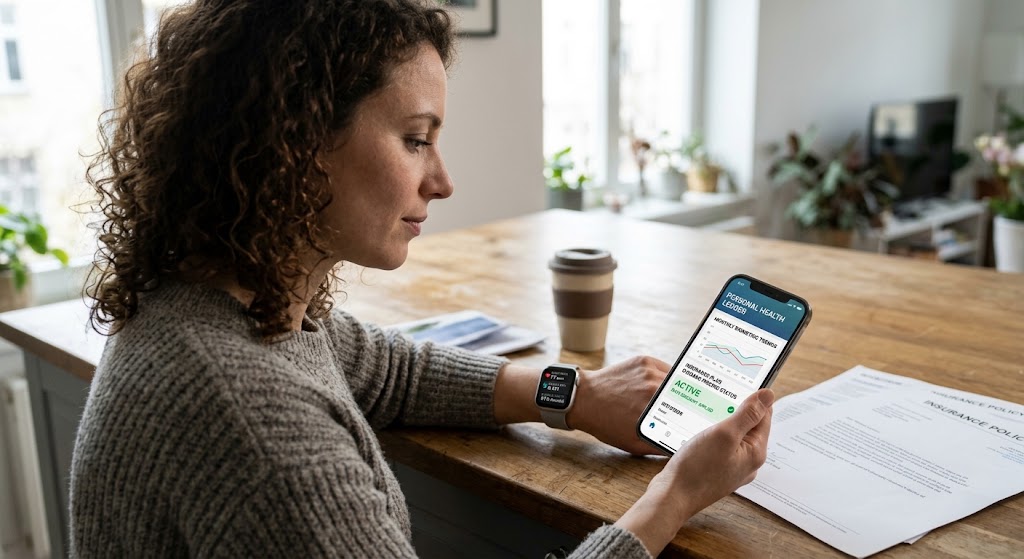
For more than a century, the financial foundation of personal life and health insurance rested on a single, static snapshot in time. A paramedical examiner would arrive at an applicant’s home, wrap a blood pressure cuff around their arm, draw a few vials of blood, collect a urine sample, and record their height and weight on a standardized form. That solitary data point was handed over to actuaries, who cross-referenced it against broad population tables to predict when the applicant might die or fall ill, locking in a fixed premium for the next ten, twenty, or thirty years.
That century-old paradigm is dissolving.
We have entered the era of the continuous biometric ledger. Across the globe, millions of policyholders are equipping themselves with high-precision optical sensors, continuous glucose monitors, and multi-wavelength photoplethysmography (PPG) arrays wrapped around their wrists, fingers, and chests. Every heart contraction, sleep cycle, oxygen saturation drop, and physical exertion event is converted into a continuous stream of telemetry.
For the insurance industry, this transition represents the most radical shift in risk assessment since the invention of the mortality table. By replacing historical averages with real-time biological data, insurers are transforming from passive financial safety nets into active, algorithmic monitors of human longevity.
Yet as real-time biometrics redefine the mechanics of underwriting, they are also dismantling the fundamental concept of shared risk, raising profound questions about privacy, systemic inequality, and what it truly means to be “insurable” in a hyper-quantified world.
The End of Static Actuarial Science
Traditional underwriting was an exercise in educated estimation. Actuaries operated on macro-level demographic cohorts: a 40-year-old non-smoking male with moderate blood pressure was categorized alongside millions of other men matching the same profile, sharing their collective risk pool.
The flaw in this model lay in its temporal blindness. A medical exam conducted on a Tuesday morning captures nothing about an individual’s chronic stress levels, erratic sleep schedules, sedentary weekends, or metabolic fluctuations over the subsequent decade. The insurer remained effectively blind to the policyholder’s real-life choices until a claim was filed.
Continuous biometric monitoring replaces this retrospective estimation with live, deterministic data streams. Insurers no longer need to guess how an individual’s health might deteriorate over time; their wearable device tracks the trajectory second by second.
This transition converts actuarial science from a static, episodic calculation into a dynamic computational engine. Instead of assessing an applicant once every decade, machine learning algorithms ingest millions of biological data points per user, evaluating baseline shifts that indicate early organ strain, metabolic degradation, or autonomic nervous system exhaustion months or years before clinical symptoms manifest.
The Mechanics of the Biometric Stream
Modern wearable devices have evolved far beyond basic step-counting pedometers. Today’s consumer health hardware delivers clinical-grade diagnostic metrics that directly correlate with all-cause mortality and chronic disease onset.
Insurers are structuring their algorithmic risk engines around several core biometric indicators:
- Heart Rate Variability (HRV): By measuring the microsecond variations between consecutive heartbeats, algorithms assess the balance between the sympathetic and parasympathetic nervous systems. Sustained low HRV serves as a powerful biomarker for chronic physiological stress, systemic inflammation, and elevated cardiovascular risk.
- Resting Heart Rate (RHR) and VO2 Max: Resting pulse rates, combined with estimated maximum oxygen uptake during exercise, provide a direct measurement of cardiorespiratory fitness. Longitudinal drops in VO2 max are tightly coupled with heightened mortality risk across all demographic groups.
- Sleep Architecture and Circadian Alignment: Photoplethysmography sensors track sleep stages, measuring deep sleep, REM continuity, and nocturnal disturbances. Chronic sleep fragmentation is increasingly factored into underwriting models as an early indicator of cognitive decline, metabolic dysfunction, and immune suppression.
- Continuous Glycemic Patterns: The integration of continuous glucose monitors (CGMs) allows insurers to evaluate real-time metabolic health, identifying insulin resistance and dangerous glucose variability long before a patient meets the clinical threshold for type 2 diabetes.
Through specialized API middleware platforms, these streams are ingested directly into insurance management software. The resulting “wearable health ledger” creates an immutable, timestamped record of an individual’s internal physiology.
Dynamic Pricing and the Psychology of “Nudge” Economics
The primary commercial vehicle for this biometric ledger is dynamic premium pricing, often marketed under the banner of interactive wellness programs.
Under traditional policy structures, premiums were fixed at inception. In the new dynamic model, the cost of coverage fluctuates based on user behavior and biological feedback. Policyholders who share their wearable data and achieve specific physiological targets receive monthly premium discounts, cash-back rebates, lower deductibles, or gift card incentives.
This model relies heavily on behavioral economics and “nudge theory.” By rewarding immediate, incremental actions—such as hitting a daily active-calorie goal, maintaining a consistent sleep schedule, or keeping resting heart rates within an optimal band—insurers attempt to actively modify customer behavior to suppress long-term claim costs.
+--------------------------------------------------------------------------+
|                     THE DYNAMIC PREMIUM REFACTORING                      |
|                                                                          |
|  Legacy Fixed Model     ---> Baseline Risk Fixed for 10-30 Years         |
|  Dynamic Biometric Model ---> Monthly Rate Adjustment Based on Live Data |
|                                                                          |
|  Optimal Biometrics     ---> Premium Rebates / Deductible Reductions     |
|  Sub-Optimal Biometrics ---> Loss of Discount / Escalating Base Rates    |
+--------------------------------------------------------------------------+
However, industry analysts note that the mathematics of dynamic pricing contain a subtle structural inversion. While presented as a voluntary discount program, the baseline price of coverage is incrementally recalibrated upward over time.
As a result, policyholders who maintain optimal biometrics are simply paying the true baseline price, while those who refuse to share their data—or whose biological metrics fail to meet algorithmic standards—face what amounts to a severe financial penalty. Opting out of the biometric ledger is rapidly becoming economically non-viable for the average consumer.
The Death of Risk Pooling: Algorithmic Atomization
While dynamic pricing offers immediate financial rewards for healthy individuals, it poses an existential threat to the core principle of personal insurance: solidarity through shared risk.
Insurance historically functioned by pooling the resources of a broad group to protect the unfortunate few who suffered unpredictable catastrophic events. Healthy policyholders effectively subsidized those who became ill, spreading the financial burden across society.
Continuous biometric monitoring replaces broad risk pools with extreme individual atomization. When an insurer can monitor an individual’s precise physiological trajectory in real time, the element of mutual risk disappears. The insurer can price coverage so accurately to the individual’s specific biological output that the financial burden shifts back onto the person.
This creates the risk of hyper-individualized “uninsurability.” If an individual’s wearable ledger reveals a persistent trend toward metabolic disease or autonomic nervous system decay, algorithms can automatically adjust premiums beyond their ability to pay, effectively cutting them off from protection before a formal medical diagnosis is ever made. The safety net is withdrawn at the exact moment it becomes necessary.
Data Sovereignty, Regulation, and the Surveillance State
The expansion of biometric underwriting has triggered severe regulatory friction regarding data privacy, consent, and ownership.
In many jurisdictions, health information collected by consumer wearables sits in a legal grey zone. While clinical data gathered in hospitals is protected by strict privacy laws like HIPAA in the United States, biometric data collected by commercial smartwatches often falls outside these statutory boundaries.
This legal ambiguity allows insurers to forge commercial partnerships with device manufacturers, aggregating massive behavioral datasets that blur the line between voluntary health management and corporate surveillance.
+--------------------------------------------------------------------------+
|                     DATA SURVEILLANCE & REGULATION                       |
|                                                                          |
|  Clinical Data (HIPAA/GDPR)  ---> Highly Protected / Strict Access       |
|  Wearable Telemetry          ---> Commercial Grey Zone / Third-Party APIs|
|  Regulatory Pushback         ---> Mandates on Biometric Underwriting     |
+--------------------------------------------------------------------------+
Regulators are scrambling to build guardrails around this data stream:
- European Union (GDPR): Under European data protection laws, biometric data processed for insurance underwriting faces strict explicit-consent mandates. Regulators are scrutinizing whether “voluntary” discounts constitute coercive financial pressure, violating the principle of freely given consent.
- State Insurance Commissions: In the United States, several state insurance regulators have introduced rules restricting the use of external consumer data streams, mandating that insurers prove a clear, actuarially sound relationship between a specific biometric metric and actual mortality risk before using it to adjust rates.
- Genetic and Biometric Discrimination: As consumer wearables integrate deeper molecular and continuous biological tracking, legal frameworks like the Genetic Information Nondiscrimination Act (GINA) are being tested by predictive algorithms that infer underlying genetic traits from continuous physiological patterns.
The Socioeconomic Divide: Encoding Structural Inequality
Beyond technical and legal concerns, the wearable health ledger threatens to exacerbate existing socioeconomic disparities in public health.
Physical health is not purely a matter of personal discipline or willpower; it is heavily shaped by social determinants—including income stability, housing quality, access to nutritious food, working environments, and environmental exposure.
Applying continuous biometric underwriting to these realities creates a systemic bias:
- Occupational Strain: A white-collar corporate worker sitting at an ergonomic desk in a climate-controlled office has far greater control over their sleep continuity, exercise schedule, and stress levels than a night-shift industrial worker, delivery driver, or manual laborer. The night-shift worker’s wearable ledger will naturally reflect disrupted circadian rhythms and elevated cortisol levels caused directly by their employment.
- Hardware Access: High-end, multi-sensor biometric devices that accurately track subtle health metrics cost hundreds of dollars, creating an entry barrier. Lower-income policyholders are often left using lower-grade trackers that offer less accurate data, or are unable to afford devices entirely, locking them out of premium discounts.
- Environmental Stress: Individuals living in high-poverty neighborhoods face elevated environmental stressors, including noise pollution, lack of green space, and food insecurity, all of which manifest as sub-optimal biometric markers on a wearable ledger.
When insurance algorithms evaluate these metrics without context, they convert structural societal disadvantages into direct financial penalties, effectively charging lower-income populations more for basic health and life coverage.
The Reinsurance Perspective: Redefining Global Capital Risk
The driving force behind the adoption of biometric underwriting is not merely consumer-facing insurance brands, but the global reinsurance industry.
Reinsurance giants—such as Swiss Re, Munich Re, and SCOR—underwrite the balance sheets of primary insurers. For these institutions, managing systemic capital risk requires moving away from delayed mortality data toward real-time predictive modeling.
By analyzing longitudinal datasets comprising billions of user-hours of wearable telemetry, reinsurers are building ultra-high-resolution mortality and morbidity models. These models allow global capital markets to detect macro-level health trends—such as the long-term cardiovascular impacts of viral infections or changing population-level exercise habits—years before they register in public national health statistics.
Reinsurers are increasingly conditioning their capital backing on the primary insurer’s ability to collect continuous biometric data. Primary insurance companies that fail to implement digital health platforms risk losing access to competitive reinsurance rates, making the transition to biometric tracking an operational necessity for the entire global financial ecosystem.
The Horizon: From Passive Payor to Active Longevity Manager
Despite the significant ethical and structural risks, the migration toward real-time biometric tracking represents a permanent evolution in human health management.
The ultimate outcome of this shift is a complete redesign of the insurance industry’s business model. For centuries, the relationship between a policyholder and their insurer was purely transactional and episodic: the customer paid a bill once a month, and the insurer paid out cash when something went wrong.
In the era of the wearable health ledger, the insurer is transforming into an active longevity manager.
By leveraging real-time telemetry, artificial intelligence models can identify silent medical emergencies in real time—detecting sub-clinical atrial fibrillation, signaling early septic shock, or identifying insulin resistance years before organ damage occurs. In this model, the insurer’s primary objective shifts from paying out death and disability claims to actively intervening to prevent those events from occurring in the first place.
If an insurer can use real-time biometric data to extend a policyholder’s life expectancy by five years, both the customer and the corporation benefit: the customer gains years of life, while the insurer delays its claim payout while continuing to collect premiums.
Yet, achieving this future requires navigating a delicate societal balance. As the human body becomes permanently tethered to global financial networks through silicon and sensors, society must decide whether the wearable health ledger will serve as a tool for personal empowerment and life extension, or as an instrument of continuous corporate surveillance and algorithmic exclusion. The boundary between corporate health management and individual human autonomy has officially blurred.