








For decades, the ambient sensory environment of modern public life—airports, railway terminals, sports bars, convention halls, and places of worship—has been defined by auditory friction. Echoing public address systems bark over low-frequency background noise; dozens of muted televisions flicker overhead in sports lounges; and individuals with hearing loss struggle against challenging room acoustics, reliant on bulky, rented assistive listening devices or outdated copper induction loops.
A fundamental transformation in wireless acoustics is quietly dismantling this paradigm.
Known as Auracast broadcast audio, a standardized capability introduced under the Bluetooth Low Energy (LE) Audio specification, this technology is altering how sound is transmitted, shared, and consumed in public spaces. Unlike traditional Bluetooth, which binds a single transmitting source to a single receiving headset through a complex pairing process, Auracast enables an audio source—such as a television, public address system, digital signage display, or smartphone—to broadcast synchronized, high-fidelity audio streams to an unlimited number of nearby receivers simultaneously.
By converting wireless audio from a private, point-to-point connection into an ambient, accessible broadcast medium, Auracast is establishing a new layer of civic infrastructure. From international transit hubs and major cultural institutions to everyday gym floors and classrooms, the technology is driving a quiet revolution in public soundscapes—one that promises to make shared spaces both acoustically peaceful and individually tailored.
The Architectural Pivot: From Point-to-Point to Open Mass Broadcast
To appreciate the significance of Auracast, one must examine the physical and protocol limitations that governed consumer wireless audio for more than twenty years.
Legacy Bluetooth—retrospectively termed Bluetooth Classic—was engineered around a strict point-to-point architecture. Establishing a connection required a manual discovery and pairing process, locking a transmitter to one, or at most two, receiving devices. This framework was further constrained by the legacy Subband Codec (SBC), which demanded significant power consumption and introduced perceptible latency, making real-time synchronization with public video monitors or live public address systems challenging.
Auracast fundamentally re-architects this relationship by leveraging Bluetooth LE Audio, formalized by the Bluetooth Special Interest Group (SIG) under the Bluetooth 5.2 specification and expanded through subsequent core updates.
At the heart of this leap is the Low Complexity Communication Codec (LC3). The LC3 codec delivers dramatically improved sound quality at less than half the bit rate of legacy SBC, drastically reducing power consumption while extending battery operational life across both transmitters and compact ear-level devices.
+-------------------------------------------------------------------------+
|                  BLUETOOTH AUDIO ARCHITECTURE EVOLUTION                 |
|                                                                         |
|  Bluetooth Classic (Legacy)  --->  Point-to-Point (1:1 Pairing)         |
|  High Bandwidth / High Power --->  High Latency (SBC Codec)             |
|                                                                         |
|  Bluetooth LE Audio / Auracast ->  Mass Broadcast (1:Unlimited)         |
|  Low Bandwidth / Low Power   --->  Ultra-Low Latency (LC3 Codec)        |
+-------------------------------------------------------------------------+
Crucially, LE Audio introduces Isochronous Channels, allowing audio transmitters to stream time-synchronized data over the air without establishing direct, bi-directional pairing locks with receiving units.
An Auracast transmitter operates similarly to a mini radio station. It streams audio data alongside lightweight advertisement packets that broadcast metadata—such as the channel name, language, content description, and bit-rate configuration. Any compatible receiving device within range—whether a premium pair of wireless earbuds, a smartphone, a smart television, or a medical hearing aid—can scan these metadata packets and instantly tune into the stream.
Because no bi-directional handshake or cryptographic pairing sequence is required between the receiving hardware and the broadcast transmitter, there is no technical ceiling on the number of simultaneous listeners. A single transmitter installed in a crowded stadium or airport terminal can serve ten listeners or ten thousand without experiencing network congestion, signal degradation, or bandwidth throttling.
Democratizing Public Accessibility: The Death of the Hearing Loop
While consumer electronics manufacturers emphasize the lifestyle conveniences of shared listening, the most immediate, high-impact application of Auracast lies in civic accessibility and assistive listening.
For decades, public venues seeking to accommodate hard-of-hearing patrons relied on Telecoil (T-Coil) induction loops, FM systems, or infrared (IR) transmitters. While functional, these legacy systems suffer from significant operational and economic drawbacks:
- Induction Loops: Require the installation of expensive copper wiring beneath flooring or inside walls, making retrofits in historic or large-scale architecture cost-prohibitive. They are also prone to electromagnetic interference from nearby power lines and structural steel.
- Infrared Systems: Require line-of-sight exposure between the transmitter and receiver, failing if a patron steps behind a pillar or into a shadowed hallway.
- FM Systems: Suffer from channel congestion, static bleed, and strict physical range constraints.
- Borrowed Hardware Overhead: All three legacy formats frequently force venues to purchase, sanitize, maintain, and hand out dedicated receiver packs and neck-loops—a process that introduces social stigma and operational friction for patrons seeking assistance.
Auracast bypasses these physical bottlenecks by integrating directly into the personal hardware that hard-of-hearing individuals already wear.
Modern hearing aids and cochlear implants manufactured by industry leaders—including GN ReSound, Cochlear, Demant, and Phonak—increasingly incorporate LE Audio chipsets natively. When an Auracast-enabled individual enters a theater, lecture hall, or place of worship, their hearing instruments can connect directly to the venue’s public address feed.
+-------------------------------------------------------------------------+
|                    ASSISTIVE LISTENING COMPARISON                       |
|                                                                         |
|  Legacy Induction Loops (T-Coil)  ---> Expensive Copper Retrofits       |
|  Infrared / FM Systems            ---> Line-of-Sight / Borrowed Hardware|
|                                                                         |
|  Auracast Broadcast Audio         ---> Zero Infrastructure Wiring       |
|                                        Direct-to-Hearing-Aid Audio      |
|                                        Unobtrusive, High-Fidelity LC3   |
+-------------------------------------------------------------------------+
The environmental sound picked up by external room microphones is bypassed, delivering crystal-clear, near-zero-latency speech directly into the listener’s auditory canal.
This capability has mobilized disability rights advocates and standards organizations globally. The Hearing Loss Association of America (HLAA) and international accessibility bodies have highlighted Auracast as a transformative tool that meets and exceeds technical requirements under accessibility mandates, such as the Americans with Disabilities Act (ADA) in the United States and similar frameworks across Europe and Asia-Pacific.
Cultural institutions—including the Sydney Opera House, the University of the Arts London, and prominent municipal spaces across Europe—have deployed Auracast transmitters to replace aging induction loops, offering patrons a unified, high-fidelity stereo experience without requiring separate equipment rentals.
The Spatial Revolution: Transforming Airports, Sports Bars, and Smart Cities
Beyond accessibility, Auracast is quietly restructuring how commercial, travel, and municipal spaces manage public acoustics. The long-term architectural goal is the reduction of ambient noise pollution—a shift toward what urban planners term “silent public environments.”
1. Transport Hubs and Micro-Targeted Public Announcements
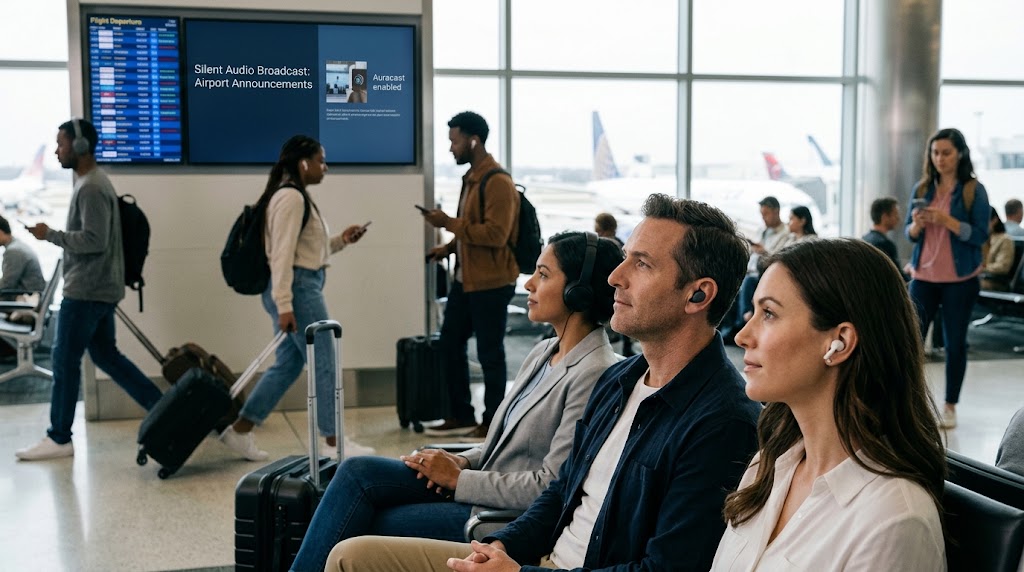
Airports and railway stations are notoriously chaotic acoustic environments. High ceilings, hard reflective surfaces, and competing terminal announcements create an unintelligible wash of reverberation. Transit operators are deploying Auracast-enabled ceiling speakers and localized transmitters at individual boarding gates and passenger lounges.
Instead of blasting gate changes or delay notices over high-decibel loudspeakers across an entire concourse, gate transmitters broadcast localized, low-power streams. Passengers waiting near Gate 14 can receive crystal-clear boarding calls piped directly into their personal earbuds or hearing aids, while passengers three gates away remain undisturbed. Furthermore, multi-language broadcasting allows international travelers to select a stream that translates gate announcements into their native language in real time.
AIRPORT TERMINAL BROADCAST TOPOLOGY

[ Gate 12 Transmitter ] ---> English / Spanish Feed  ---> Local Passengers
[ Gate 14 Transmitter ] ---> English / Mandarin Feed ---> Local Passengers
[ Main Concourse PA ]   ---> Emergency Sync Stream  ---> Terminal-Wide Override
2. Silent Commercial Screens in Hospitality and Gyms
Sports lounges, airport bars, and fitness centers frequently feature dozens of wall-mounted screens muted to prevent a chaotic clash of audio feeds. Auracast solves this visual-auditory disconnect.
Each screen or video wall can be attached to a low-cost Auracast transmitter broadcasting its specific commentary feed. Patrons sitting in a sports bar can open an application on their smartphone or tap a smart wearable, select “Screen 4 – European Football” or “Screen 12 – Financial News,” and listen privately in real-time high definition without adding a single decibel of ambient noise to the venue.
3. Multi-Lingual Museums and Educational Spaces
In educational institutions, museums, and international conference halls, Auracast eliminates the need for specialized tour guide hardware. A museum docent wearing a wireless microphone transmitter can address a group of fifty visitors simultaneously, with each visitor receiving the live commentary on their personal headphones. In multi-lingual environments, real-time translation feeds can be broadcast on parallel Auracast channels, allowing listeners to select their preferred language channel instantly.
Silicon Saturation and the Hardware Tipping Point
The transition from a promising wireless standard to global commercial infrastructure requires deep alignment across semiconductor manufacturers, operating system developers, and hardware OEMs. That critical threshold has been crossed.
+-------------------------------------------------------------------------+
|                  THE AURACAST HARDWARE & SOFTWARE STACK                 |
|                                                                         |
|  Silicon Layer       ---> Qualcomm QCC Series, MediaTek, TI SoCs        |
|  Operating System    ---> Android (Native LE Audio), iOS, Windows 11    |
|  Consumer Receivers  ---> Smartphones, Earbuds, Hearing Aids, TVs       |
|  Public Transmitters ---> Commercial PA Systems, In-Ceiling Modules     |
+-------------------------------------------------------------------------+
Silicon and Chipset Foundations
Leading semiconductor vendors—including Qualcomm (with its S3, S5, and QCC series audio platforms), MediaTek (Dimensity platforms), and Texas Instruments—have made Bluetooth 5.2+ and LE Audio compatibility standard across their mid-range and flagship system-on-chip (SoC) architectures. This hardware saturation ensures that virtually every newly manufactured smartphone, premium earbud set, and commercial audio transmitter leaves the factory physically equipped for Auracast operations.
Operating System Integration
Software integration has advanced rapidly across major consumer platforms:
- Android: Google introduced native LE Audio and Auracast scanning frameworks within Android, allowing users to search for, discover, and join nearby audio broadcasts directly through the system control center, mirroring the intuitive interface used for selecting local Wi-Fi networks.
- Apple Ecosystem: Apple has systematically updated its hardware portfolio to support Bluetooth 5.3 and LE Audio primitives across iPhone, iPad, and Mac lineups, aligning its ecosystem with global broadcast standards.
- Windows: Microsoft embedded native LE Audio controls into Windows 11, enabling laptops and desktop workstations to transmit or receive multi-stream broadcast audio natively for enterprise collaboration and accessibility.
Market Trajectory
Market intelligence data from firm Dataintelo highlights the commercial acceleration of this technology. The global Auracast Broadcast Audio market—valued at approximately $1.8 billion in 2025—is projected to reach $9.6 billion by 2034, expanding at a compound annual growth rate (CAGR) of over 20 percent.
Industry estimates project that by 2028, Auracast capabilities will be included as a standard feature in over 60 percent of all new wireless audio hardware shipped globally, driven by high adoption rates across North America, Europe, and the Asia-Pacific region.
Technical Challenges: RF Management, Latency, and Security
While the benefits of Auracast are immense, deploying reliable mass-broadcast audio environments across complex physical infrastructure presents nontrivial engineering and regulatory challenges.
1. Radio Frequency (RF) Environment Mapping and Coexistence
The 2.4 GHz ISM (Industrial, Scientific, and Medical) radio frequency band—where Bluetooth operates—is notoriously congested, crowded with Wi-Fi networks, legacy Bluetooth devices, microwave emissions, and industrial sensors.
In high-density environments like international airports or crowded convention centers, deploying dozens of adjacent Auracast transmitters requires meticulous RF channel planning and site surveys. System integrators must balance transmission power to prevent channel overlap and packet loss while ensuring signal coverage extends across designated passenger or seating zones.
2. Audio Synchronization and Latency Management
For applications involving live speech or visual displays—such as lip-syncing with a television monitor or listening to a theater stage performance—audio latency must remain well below 40 milliseconds to prevent noticeable lip-sync delay.
While the LC3 codec natively operates at ultra-low latencies (often between 15 and 30 milliseconds), venue operators must ensure that incoming audio feeds, digital signal processors (DSPs), and network distribution backbones do not introduce cumulative processing delays before the signal ever reaches the Auracast transmitter.
AUDIO PIPELINE LATENCY BUDGET

[ Live Microphone / TV Feed ]
              │
              ▼  (DSP / Network Transport: ~5-10ms)
[ Auracast Commercial Transmitter ]
              │
              ▼  (LE Audio / LC3 Transmission: ~15-20ms)
[ Personal Earbuds / Hearing Aid ]
              │
              ▼
  TOTAL SYSTEM LATENCY: < 35ms (Imperceptible to Human Ears)
3. Stream Security and Privacy Controls
Not all public audio streams are intended for universal consumption. While airport announcements and sports bar televisions utilize open, unencrypted broadcasts, enterprise application scenarios—such as confidential corporate boardrooms, private university lectures, or courtroom proceedings—require strict access controls.
The Auracast specification accounts for this through encrypted broadcast profiles. Transmitters can broadcast encrypted streams that require a security key or PIN to join. Users can receive the decryption key via a secure QR code scan, an NFC tap upon entering a room, or an authenticated corporate event application, ensuring that sensitive audio streams remain protected against unauthorized interception by nearby receivers.
The Future Soundscape: Intentional, Personalized, and Quiet
The emergence of Auracast represents a profound shift in human interaction with public acoustic spaces. For more than a century, public audio was an exercise in acoustic force—amplifying sound through massive loudspeakers to override background noise, forcing everyone within a physical space to consume the same sound, regardless of preference, hearing ability, or language.
Auracast replaces this blunt force approach with precision, choice, and quiet inclusion.
As venue operators, transit authorities, cultural institutions, and consumer technology brands complete their integration of LE Audio infrastructure, the modern urban environment will undergo a noticeable acoustic softening. Overhead noise pollution will recede, replaced by personalized, high-definition audio streams delivered directly to the user’s ear of choice.
The true victory of Auracast is not merely technical efficiency or commercial market growth; it is the silent democratization of sound. By bridging the long-standing divide between public acoustics and personal hearing assistance, Auracast is building a world where shared spaces can remain quiet, accessible, and meaningful to every listener.