








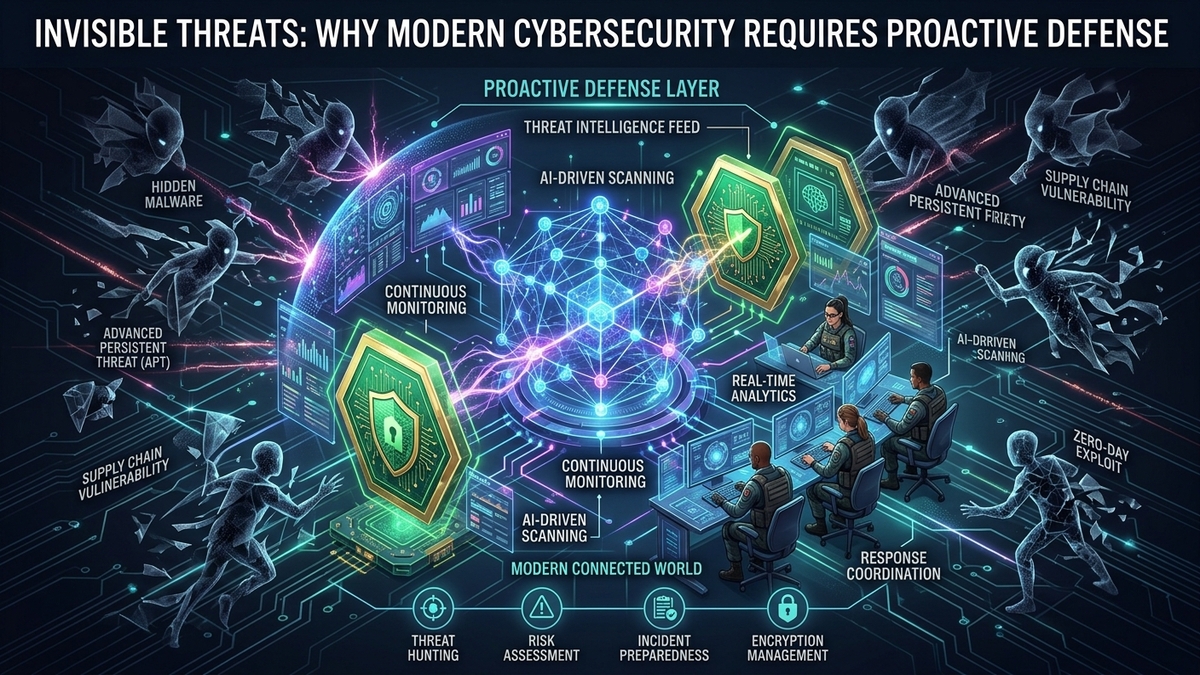
The fundamental premise of traditional cybersecurity—that organizations can build a sufficiently tall digital perimeter to keep malicious actors out—has quietly collapsed. For decades, enterprise security strategies relied on reactive defense models: deploying firewalls, installing antivirus software on endpoints, and waiting for security information and event management (SIEM) systems to trigger an alert before responding to a breach.
That reactive philosophy is entirely inadequate against the modern threat landscape. Today’s cyber adversaries are no longer isolated script kiddies or low-level scammers launching noisy, predictable attacks. They are highly organized, well-funded cybercrime syndicates and state-sponsored advanced persistent threat (APT) groups using sophisticated, low-visibility tactics designed specifically to bypass perimeter controls unnoticed.
As corporate network perimeters dissolve due to cloud migration, hybrid remote work, and interconnected third-party vendor supply chains, the attack surface has expanded exponentially. Modern threats operate silently within corporate networks for weeks or months—exfiltrating sensitive intellectual property, escalating privileges, and corrupting backups—long before any visible damage, such as a ransomware payload, is detonated.
Navigating this reality requires an immediate operational shift. Organizations must move away from reactive incident response toward continuous proactive defense: assuming compromise, hunting for threats preemptively, automating real-time mitigation, and building resilient zero-trust architectures capable of containing attacks before they transform into business-ending catastrophes.
The Anatomy of Invisible Attacks: Living off the Land and Fileless Malware
The primary reason modern threats remain invisible to traditional security tools is a fundamental shift in adversary tactics. Historically, malicious actors deployed custom malware files onto target systems. Traditional security software easily detected these files by matching their cryptographic hashes or behavioral signatures against databases of known threats.
Modern attackers have largely abandoned noisy malware files in favor of evasive techniques that abuse legitimate system tools—a strategy known as “Living off the Land” (LotL).
Traditional Attack Vector:
Attacker → Drops Malicious Executable (.exe) → Antivirus Detects File Hash → Attack Blocked

Modern Evasive Vector (LotL):
Attacker → Executes Native System Tool (PowerShell/WMI) → Blends with Legitimate Traffic → Perimeter Passed
By abusing built-in administrative utilities—such as PowerShell, Windows Management Instrumentation (WMI), Remote Desktop Protocol (RDP), and legitimate remote management software—attackers execute commands directly in a system’s volatile memory (RAM). Because no malicious file is ever written to the hard drive, standard disk-scanning antivirus tools see nothing out of the ordinary.
To a traditional monitoring system, an attacker executing a memory-only script via PowerShell looks identical to a legitimate system administrator performing routine maintenance. Attackers use these evasive techniques to achieve subtle, long-term operational goals:
- Credential Harvesting: Extracting valid user domain passwords directly from memory structures using native system calls, allowing attackers to move laterally across networks using legitimate credentials.
- Defense Evasion: Silently disabling security monitoring agents, deleting local event logs, and modifying registry keys without triggering automated security alerts.
- Exfiltration via Legitimate Cloud Services: Encrypting sensitive corporate data and exfiltrating it over standard HTTPS connections to legitimate public cloud storage providers, disguising stolen data transfers as normal business traffic.
By blending seamlessly into the ambient noise of daily IT operations, modern attackers can maintain persistent access to corporate networks for extended periods, executing complex espionage or data theft operations completely undetected by perimeter tools.
The Collapse of the Network Perimeter and Supply Chain Risks
The rise of invisible threats has been further accelerated by the structural disintegration of the traditional corporate network perimeter. The widespread adoption of multi-cloud environments, distributed remote workforces, and mobile endpoint devices means that corporate data no longer resides behind a single physical office firewall.
This architectural shift has drastically multiplied entry points for malicious actors, with software supply chain compromises emerging as one of the most dangerous and evasive attack vectors.
Rather than attacking a heavily fortified enterprise directly, sophisticated threat actors target the trusted third-party software vendors, managed service providers (MSPs), and open-source code libraries that the enterprise relies upon. By compromising a vendor’s software build pipeline or pushing a malicious update to a widely used software utility, attackers gain instant, authenticated administrative access to thousands of downstream corporate networks simultaneously.
Attacker Operations
       ↓
Compromise Third-Party Vendor Build Pipeline
       ↓
Digitally Signed Software Update Issued
       ↓
Downstream Enterprise Automatically Installs "Trusted" Update
       ↓
Invisible Breach Established Across Corporate Network
Because downstream organizations trust the digitally signed update from their vendor, traditional security controls bypass inspection entirely. The malicious code enters the target network through an authenticated, trusted door, allowing attackers to establish backdoor access without raising a single alarm.
Furthermore, the expansion of interconnected Application Programming Interfaces (APIs) across modern cloud infrastructure creates significant visibility gaps. Misconfigured APIs, unmonitored legacy endpoints, and overly permissive cloud access roles allow attackers to hop between cloud environments and internal databases completely unnoticed by perimeter tools.
The Proactive Defense Framework: Threat Hunting, Zero Trust, and AI
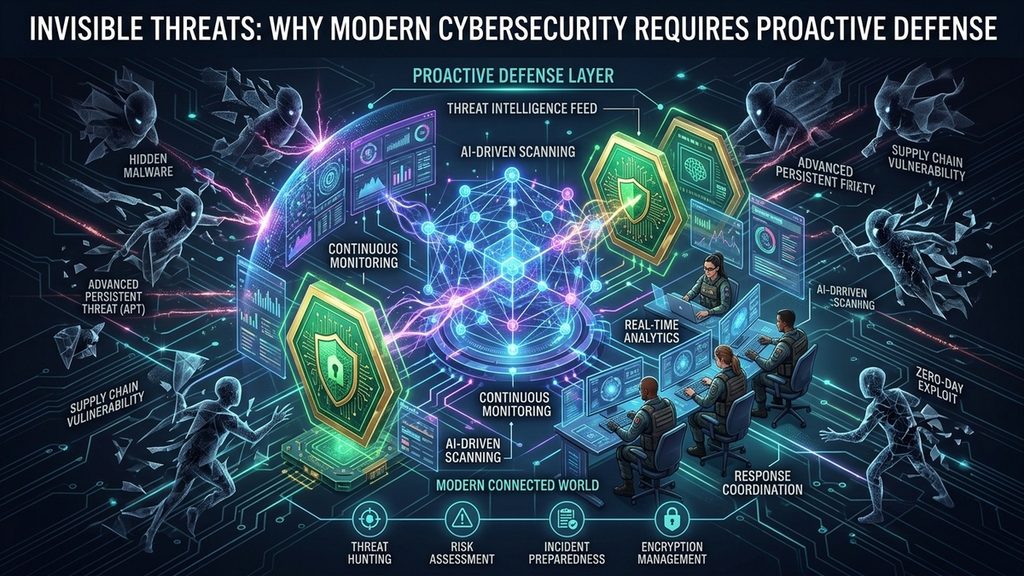
Defending against invisible, low-visibility threats requires replacing reactive perimeter security with a proactive defense framework. Organizations must operate under a foundational philosophy: “Assume Breach.” Proactive security assumes that malicious actors are already inside the network and actively builds architectures designed to detect, contain, and neutralize them in real time.
                    Proactive Defense Framework
                                 │
     ┌───────────────────────────┼───────────────────────────┐
     ▼                           ▼                           ▼
Continuous Threat           Zero Trust             AI-Driven Automated
     Hunting              Architecture                  Response
 (Hypothesis-Driven       (Never Trust,              (Behavioral Anomaly
 Searching for LotL)    Always Verify Access)         Detection at Scale)
1. Continuous Hypothesis-Driven Threat Hunting
Threat hunting is the proactive, human-led practice of searching through corporate networks to detect hidden adversaries that have bypassed automated security controls. Unlike passive security monitoring—which waits for a software alert to fire—threat hunters operate on hypotheses based on current threat intelligence.
Threat hunters continuously analyze endpoint telemetry, network traffic flows, and user activity logs, looking for subtle anomalies that indicate malicious presence:
- Unusual execution of administrative command-line tools outside normal business hours.
- Unexpected internal network connections originating from non-administrative user workstations.
- Minor spikes in outbound data transfers to rare, non-standard IP addresses.
By combining deep domain expertise with advanced endpoint detection and response (EDR) telemetry, threat hunters identify and isolate invisible adversaries early in the attack lifecycle—long before they can execute their primary objectives.
2. Implementing Zero Trust Architecture (ZTA)
A core pillar of proactive defense is Zero Trust Architecture. Built on the guiding principle “Never Trust, Always Verify,” Zero Trust discards the outdated idea that users or devices inside the corporate network are inherently safe.
Zero Trust requires explicit identity verification, device health validation, and strict contextual access controls for every access request, regardless of whether it originates inside or outside the physical network:
- Micro-Segmentation: Dividing networks into small, isolated security zones. If an attacker gains access to one compromised workstation, micro-segmentation prevents them from moving laterally to sensitive financial or customer databases.
- Least Privilege Access: Restricting user accounts and automated software applications to the absolute minimum access levels required to perform their specific job functions, limiting the impact of stolen credentials.
- Continuous Multi-Factor Authentication (MFA): Evaluating contextual risk factors—such as user location, device posture, and time of access—in real time, prompting re-authentication whenever an anomaly is detected.
3. AI-Driven Automated Response and Behavioral Analytics
The sheer volume of security telemetry generated by modern cloud networks exceeds human cognitive capacity. Proactive defense leverages artificial intelligence, machine learning algorithms, and User and Entity Behavior Analytics (UEBA) to process millions of event logs per second, establishing precise baselines of normal network behavior.
When an anomaly occurs—such as a user account accessing an unusual cloud database while attempting to run an unapproved PowerShell script—the AI detection platform identifies the deviation instantly.
Crucially, proactive defense pairs AI detection with Security Orchestration, Automation, and Response (SOAR) platforms. Rather than generating a manual ticket for a human analyst to review hours later, automated SOAR playbooks execute immediate containment actions within seconds: isolating the compromised workstation from the network, revoking the compromised user’s active session tokens, and blocking suspicious IP addresses at the perimeter.
Metrics That Matter: Shifting from Dwell Time to Active Resiliency
Transitioning to a proactive defense model requires executive leadership and board directors to reconsider how cybersecurity success is measured. Historically, organizations focused on vanity metrics, such as the total number of blocked malware attacks or the speed at which software patches were applied.
In a threat landscape dominated by invisible attacks, executive teams must prioritize metrics that measure active visibility, detection speed, and containment effectiveness:
| Security Metric | Operational Focus | Proactive Benchmark Target |
| Mean Time to Detect (MTTD) | The average time required to identify a security threat after initial compromise. | Reduced from months to minutes or hours via threat hunting and AI telemetry. |
| Mean Time to Contain (MTTC) | The average time required to isolate a compromised asset and stop lateral movement. | Near-instantaneous execution via automated SOAR playbooks. |
| Dwell Time | The total duration an adversary remains undetected inside a corporate network. | Minimized aggressively to prevent data exfiltration or privilege escalation. |
| Threat Hunt Coverage | The percentage of critical enterprise assets actively monitored by proactive hunting teams. | 100% coverage across core identity servers, cloud databases, and endpoints. |
By tracking and optimizing these proactive metrics, enterprise leaders transform security from an unpredictable reactive emergency expense into a predictable, measurable operational discipline.
Building a Culture of Vigilance and Strategic Resiliency
Ultimately, technology alone cannot build a proactive defense. The technical architectures of threat hunting, Zero Trust, and AI automation must be supported by an organizational culture of continuous vigilance.
Human error—such as falling for sophisticated spear-phishing campaigns, misconfiguring cloud storage buckets, or reusing weak credentials—remains a primary entry point for modern threat actors. Proactive organizations invest in continuous, context-aware security training that empowers employees to recognize social engineering tactics, report anomalies promptly, and understand their role as active defenders of the enterprise.
Furthermore, corporate leadership must recognize that cyber resilience is a strategic business enabler, not merely an IT department expense. In a modern economy powered by digital transactions and cloud networks, an organization’s ability to withstand, contain, and operate through a sophisticated cyber attack directly determines its market reputation, customer trust, and long-term viability.
The invisible threats navigating modern networks do not respect traditional perimeters, corporate boundaries, or passive defenses. Organizations that continue to rely on reactive security models will inevitably find themselves responding to catastrophic breaches after the damage is already done.
By embracing proactive defense—combining continuous threat hunting, Zero Trust architectures, AI-driven automation, and a culture of relentless vigilance—enterprises can strip away the adversary’s element of surprise, uncover hidden threats in real time, and secure their digital future in an interconnected world.