






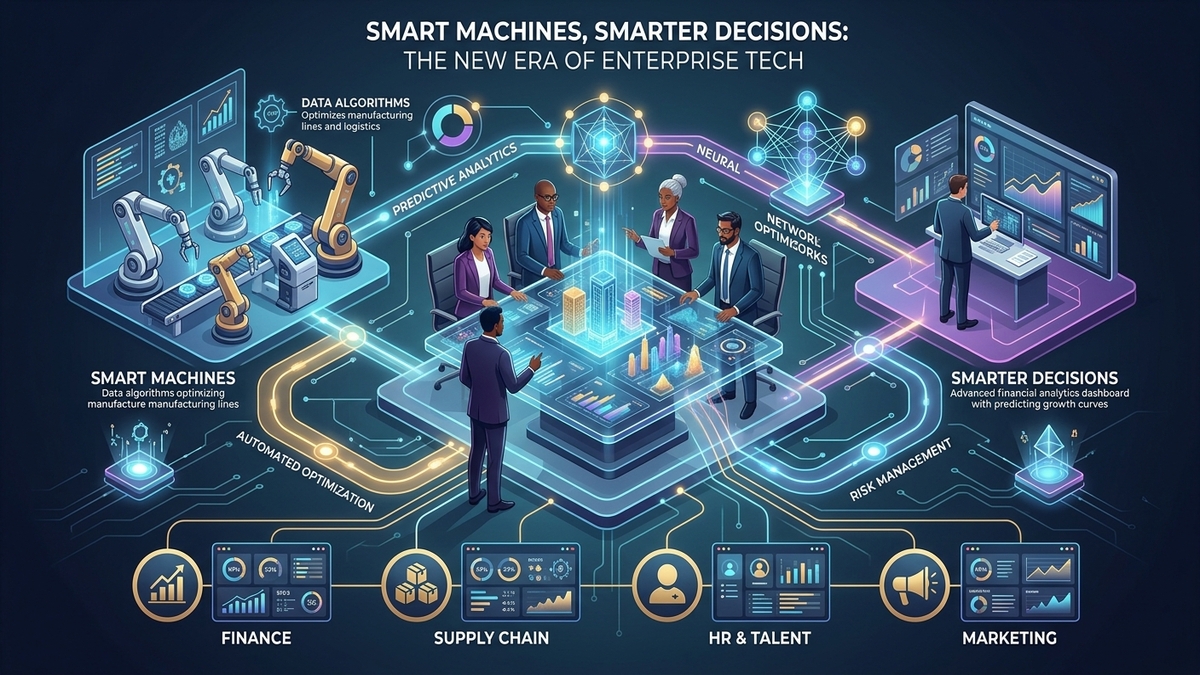
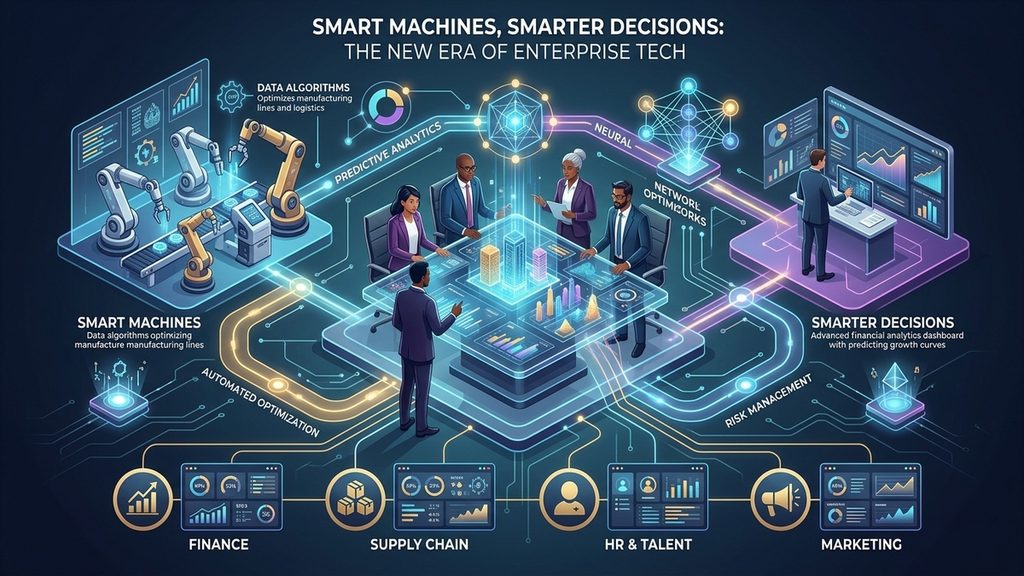
Across executive suites, corporate boardrooms, and industrial operations worldwide, a fundamental quiet shift has reshaped how global businesses compete. The initial era of enterprise artificial intelligence—characterized by experimental software pilots, standalone conversational chatbots, and passive analytical dashboards—has rapidly drawn to a close. In its place, a far more impactful operational paradigm has emerged: the era of integrated decision intelligence and smart machine orchestration.
For decades, digital transformation efforts focused on gathering data to inform human decision-makers. Systems generated reports, highlighted trends, and populated executive cockpits with visualization charts, leaving business leaders to manually synthesize the information, weigh alternatives, and execute operational changes. Today, that linear workflow is being superseded by closed-loop autonomous architectures. Smart machines—combining agentic software, domain-specific reasoning models, and physical robotics—are no longer merely surfacing insights; they are actively evaluating multi-variable scenarios, recommending precise actions, and executing operational decisions in real time across global enterprise networks.
This evolution represents more than an incremental upgrade in software efficiency. It marks a structural shift in corporate governance, capital allocation, and human labor. As organizations face volatile global supply chains, fluctuating energy costs, and relentless competitive pressures, the primary determinant of enterprise value is no longer how much data a company collects, but how fast and accurately its technology translates that data into intelligent, verifiable decisions.
From Passive Dashboards to Autonomous Execution
To understand the magnitude of this transition, it is necessary to examine how the unit of enterprise work has evolved. The first wave of enterprise AI adoption was predominantly advisory.Systems provided “assisted intelligence,” summarizing lengthy documents, generating preliminary text, or categorizing customer service tickets.While useful, the underlying business operating model remained unchanged: a human employee initiated the task, evaluated the output, context-switched between applications, and remembered what needed to happen next.
The second wave, driven by agentic AI and intelligent automation, changes the operational dynamic entirely.Rather than waiting for sequential human prompts, agentic systems act as digital co-workers. They are assigned overarching business objectives—such as rebalancing regional inventory to mitigate a looming port delay, optimizing liquidity across international bank accounts, or adjusting dynamic pricing models in response to localized demand surges. The agent decomposes the goal into structured sub-tasks, queries internal enterprise resource planning (ERP) systems, interacts with external vendor application programming interfaces (APIs), evaluates risk parameters, and executes the necessary transactions.
Market data reflects this rapid transition.Research from major technology analysts indicates that the percentage of enterprise applications embedding task-specific AI agents has surged, growing from less than 5 percent in 2025 to a forecasted 40 percent by the end of 2026. Furthermore, multi-agent frameworks—where specialized algorithms collaborate, peer-review intermediate outputs, and hand off tasks—have been shown to cut process handoffs nearly in half while accelerating complex operational decision cycles threefold.
Enterprise decision-making is increasingly categorized across three distinct levels of maturity:
- Assisted Decisions:Intelligent software surfaces relevant data, patterns, and options, but human operators maintain full responsibility for analyzing alternatives and making the final choice. This approach remains common in high-stakes strategic mergers, long-term capital investments, and complex executive hiring.
- Augmented Decisions:Machine learning models process vast data streams to significantly narrow the decision space, recommending a primary action alongside statistical confidence scores.Humans function as approvers rather than originators, validating the system’s choice before execution. This model is widely deployed in commercial credit underwriting, clinical triage, and complex procurement routing.
- Automated Decisions:Smart machines evaluate incoming variables and execute actions instantaneously without human intervention, operating within pre-approved policy parameters.This framework has become standard in high-frequency fraud detection, real-time algorithmic energy trading, and dynamic warehouse inventory management.
By shifting routine operational choices from human review queues to automated execution frameworks, leading enterprises are capturing significant speed and accuracy advantages, transforming technology from an administrative cost center into an active driver of operational margin.
The Architecture of Decision Intelligence
The transition toward autonomous enterprise execution is supported by a fundamental redesign of corporate technology stacks. The early assumption that enterprises could simply layer massive, general-purpose public language models onto existing legacy databases has proven economically and operationally unviable. Frontier language models, while highly capable across open-ended creative domains, present high latency, significant cloud compute costs, and potential data privacy risks when exposed to sensitive corporate IP.
Consequently, the architecture powering modern decision intelligence is built on specialized, right-sized infrastructure designed specifically for enterprise reliability.
At the center of this shift is the rapid adoption of Small Language Models (SLMs) and task-specific reasoning engines. Fine-tuned on specialized domain data and running either on-device, at the local network edge, or within private corporate clouds, these compact models deliver high mathematical and logical precision at a fraction of the operational cost. In cost-sensitive deployments, targeted SLMs perform specific analytical subroutines with lower latency and higher consistency than general-purpose frontier models.
A robust enterprise decision intelligence platform requires four integrated technical layers:
- Unified Data Architecture:Decision algorithms require clean, structured, and continuously updated data pipelines.Leading organizations rely on modern lakehouse architectures and real-time event-streaming platforms that break down functional data silos between sales, finance, human resources, and supply chain systems.
- Reasoning and Model Orchestration: Rather than relying on a single monolithic algorithm, modern systems utilize multi-model routing engines. When an operational query arrives, the orchestrator evaluates the task’s complexity, assigning deterministic logic rules to symbolic engines while routing spatial or predictive tasks to specialized machine learning models.
- Operational System Integration: An analytical insight locked within a data science workspace generates zero economic value. Decision intelligence models are embedded directly into operational software—such as SAP, Salesforce, Oracle, or custom manufacturing execution systems (MES)—allowing the system to trigger purchase orders, reallocate server capacity, or issue customer credits without manual friction.
- Continuous Telemetry and Drift Monitoring:Because real-world environments change, models experience “drift” as baseline economic conditions, customer behaviors, or supply chain realities evolve. Automated telemetry tools continuously monitor decision accuracy against real-world outcomes, flagging degrading performance and queueing models for retraining before errors compound.
This architectural evolution has also given rise to dedicated financial oversight. As enterprises scale thousands of automated agents and inference endpoints across global operations, cloud compute costs can escalate rapidly. Enterprise technology management now routinely incorporates dedicated financial operations (FinOps) disciplines specifically focused on tracking, auditing, and optimizing AI infrastructure budgets to ensure that automated decision-making yields a clear return on investment.
Physical AI and Industrial Automation: Bridging Bits and Atoms
While decision intelligence software optimizes digital workflows inside corporate networks, smart machines are simultaneously transforming physical operations. The convergence of multimodal artificial intelligence, low-latency edge computing, and advanced mechanical hardware has accelerated the rise of physical AI—autonomous systems, collaborative robotics, and spatial intelligence deployed directly into industrial environments.
Historically, industrial automation was rigid and capital-intensive. Robots on manufacturing plants or automotive assembly lines operated inside physical safety cages, executing hard-coded mechanical movements over millions of identical cycles. If a component was positioned slightly out of alignment or a different material was introduced, the line halted until a technician manually reprogrammed the machinery.
Physical AI platforms break this limitation by combining vision-language-action (VLA) foundation models with real-time sensory feedback. Equipped with spatial perception, these smart machines operate safely alongside human workers in dynamic, unstructured environments. They perceive surrounding physical spaces, interpret visual and thermal anomalies, adapt to unexpected material variations, and execute complex assembly, sorting, or maintenance tasks without requiring explicit line-by-line coding.
In supply chain warehousing and logistics fulfillment centers, fleets of autonomous mobile robots (AMRs) dynamically coordinate their movements to optimize inventory picking routes, adjust to floor congestion, and autonomously re-stack damaged cargo shipments. In heavy industrial settings—such as oil refineries, steel mills, and energy grid substations—autonomous inspection drones and legged robotic platforms conduct continuous thermal and acoustic monitoring, identifying microscopic structural micro-fractures or chemical leaks before catastrophic mechanical failures occur.
The economic impact of bridging physical operations with intelligent decision systems is substantial. Global industrial research indicates that AI-driven demand forecasting combined with physical warehouse automation cuts inventory forecasting errors by 30 to 50 percent while reducing overall holding inventory by up to half.In energy and heavy manufacturing, predictive maintenance orchestrated by smart machines consistently yields double-digit reductions in downtime and equipment repair costs. Physical machines are no longer passive mechanical muscle; they have become intelligent, perception-driven nodes within the broader enterprise computing network.
Governance, Identity, and the Control Point
As smart machines transition from assisting humans to executing multi-step workflows autonomously, corporate governance and risk management face an unprecedented challenge. When an employee makes an operational mistake, traditional corporate frameworks rely on clear chains of command, policy manuals, and personnel accountability. But when an autonomous software agent or physical machine makes a costly error—misinterpreting a procurement contract, misallocating capital, or triggering an unintended operational shutdown—determining liability becomes complex.
In 2026, the primary control point for enterprise technology adoption has shifted decisively from model performance to identity, permissioning, and auditability.The central question for corporate risk officers is no longer simply whether an algorithm can perform a task, but whether the organization can prove precisely how the decision was reached, under whose authority the machine acted, and whether it strictly adhered to corporate policy and regulatory mandates.
To address this challenge, leading enterprise software providers and corporate IT departments are treating autonomous AI agents as first-class digital identities. Rather than allowing algorithms to run under generic system administrator accounts or unmonitored API tokens, enterprises are deploying digital worker governance frameworks that incorporate:
- Role-Based Access Control (RBAC): Assigning explicit permission boundaries to every automated agent, restricting its access to specific databases, transaction limits, and software systems based on its defined business role.
- Immutable Audit Logging and Provenance: Recording every intermediate step, reasoning path, source data point, and API call executed by a smart machine into encrypted, tamper-evident digital ledgers. This creates a complete post-hoc audit trail for internal compliance reviews and external regulatory inspections.
- Deterministic Guardrails and Human Checkpoints: Enforcing hard-coded policy barriers that automatically freeze an agent’s agency and escalate the workflow to a human manager if a recommended transaction exceeds specific financial, operational, or legal risk thresholds.
- Explainable AI (XAI) Protocols:Utilizing neuro-symbolic design and mathematical verification tools to ensure that complex model outputs can be clearly explained in human-understandable logic—a mandatory requirement in highly regulated sectors such as banking, insurance, and healthcare.
This governance-first methodology is further reinforced by global regulatory enforcement. Comprehensive legal structures, such as the European Union’s Artificial Intelligence Act, mandate strict risk assessments, continuous post-market monitoring, and human oversight for high-risk automated deployments. Organizations that fail to build robust auditability into their smart machine infrastructure face significant financial exposure and reputational damage.
Re-Engineering Workflows and Human Leadership
The proliferation of smart machines and decision intelligence does not signal the end of human labor; rather, it forces a fundamental re-engineering of workplace roles and organizational structures. As software algorithms absorb the routine mechanics of data collation, preliminary analysis, and administrative coordination, human workers are transitioning from primary execution agents to strategic supervisors, auditors, and creative directors.
In financial operations, an accountant spends less time manually reconciling ledgers and more time evaluating the strategic assumptions underlying automated risk models. In customer relations, service representatives delegate routine inquiries to automated agents, focusing their time on managing high-friction emotional escalations that demand human empathy and nuanced judgment. In software engineering, developers evolve from manual coders into system architects who oversee autonomous coding agents, auditing generated software for security, compliance, and structural integrity.
However, this transition introduces a significant operational hurdle: managing “automation bias” and skill degradation. When automated decision platforms operate smoothly over long periods, human workers naturally develop a high degree of trust in machine outputs. Over time, critical thinking can recede, leading staff to approve algorithmic recommendations without scrutinizing underlying anomalies. If an algorithm quietly miscalculates a demand forecast or misclassifies an operational risk due to unexpected market changes, human supervisors who have grown overly reliant on the system may fail to spot the error before it propagates.
Furthermore, corporate leaders face a structural training dilemma. Historically, junior employees developed domain expertise, institutional knowledge, and strategic intuition by performing the exact routine analytical tasks that smart machines now handle automatically. To prevent a future talent gap, forward-thinking enterprises are rebuilding onboarding and professional development programs. These initiatives place a heavy emphasis on critical thinking, scenario testing, algorithmic auditing, and interdisciplinary problem-solving, ensuring that early-career professionals acquire the deep domain knowledge required to steward automated enterprises effectively.
Compounding the Advantage in the Convergent Era
The enterprise tech landscape has entered a mature, demanding phase. The speculative enthusiasm that characterized the early generative AI wave has been replaced by a rigorous focus on measurable return on investment, operational resilience, and verifiable governance.
Smart machines and decision intelligence platforms represent a structural shift in how businesses operate.By converting vast, complex data streams into rapid, accurate, and automated decisions, organizations are stripping friction out of their operating models and building dynamic supply chains, hyper-efficient financial structures, and highly responsive industrial footprints.
The gap between early enterprise adopters and latecomers is widening rapidly. Organizations that successfully integrate intelligent agents, physical AI, and robust governance into a cohesive human-machine ecosystem are generating compounding operational advantages that competitors relying on traditional, manual workflows will find increasingly difficult to match.
Ultimately, the goal of this new era of enterprise technology is not to replace human wisdom with algorithmic processing. The true potential of smart machines lies in their ability to absorb mechanical complexity, process high-dimensional data at scale, and execute routine choices instantaneously—liberating human leadership to focus on vision, ethics, strategic innovation, and the qualitative decisions that define the future of global enterprise.