








For nearly three decades, corporate cybersecurity was defined by a single, intuitive metaphor: the medieval castle and moat. Organizations erected tall, rigid digital perimeters around their physical offices—employing firewalls, intrusion prevention systems, and virtual private networks (VPNs) to keep external bad actors out while granting implicit trust to everyone inside. If a user was physically present in the office or logged in through a corporate VPN, the network assumed they were legitimate and granted broad access to internal files, servers, and applications.
That architecture is now entirely obsolete. The structural shift toward hybrid work, accelerated by the global adoption of multi-cloud environments, mobile endpoints, and third-party software-as-a-service (SaaS) platforms, has dissolved the traditional corporate perimeter. Today, sensitive corporate data resides simultaneously on local servers, public cloud repositories, personal laptops, and mobile devices connected to unencrypted home Wi-Fi networks and public coffee shop access points.
In this decentralized reality, implicit trust has become an intolerable vulnerability. When an attacker compromises a single user credential or home device on a traditional network, the perimeter framework allows them to move laterally across internal systems completely unhindered—a soft interior protected only by a hard outer shell.
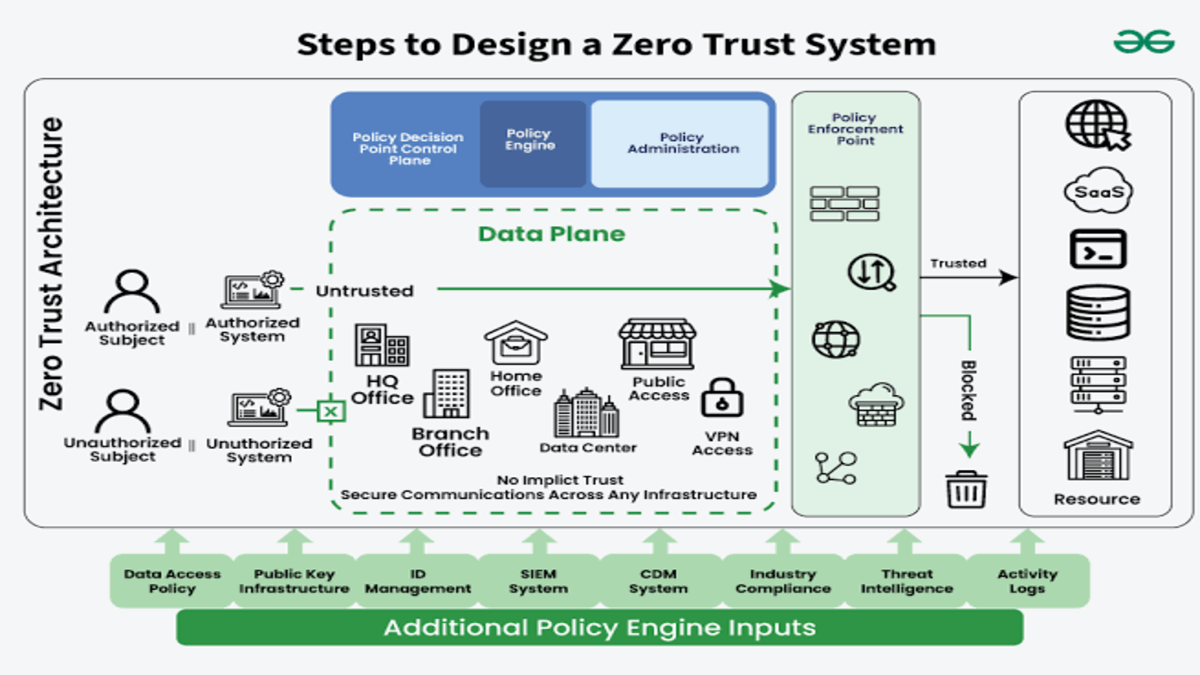
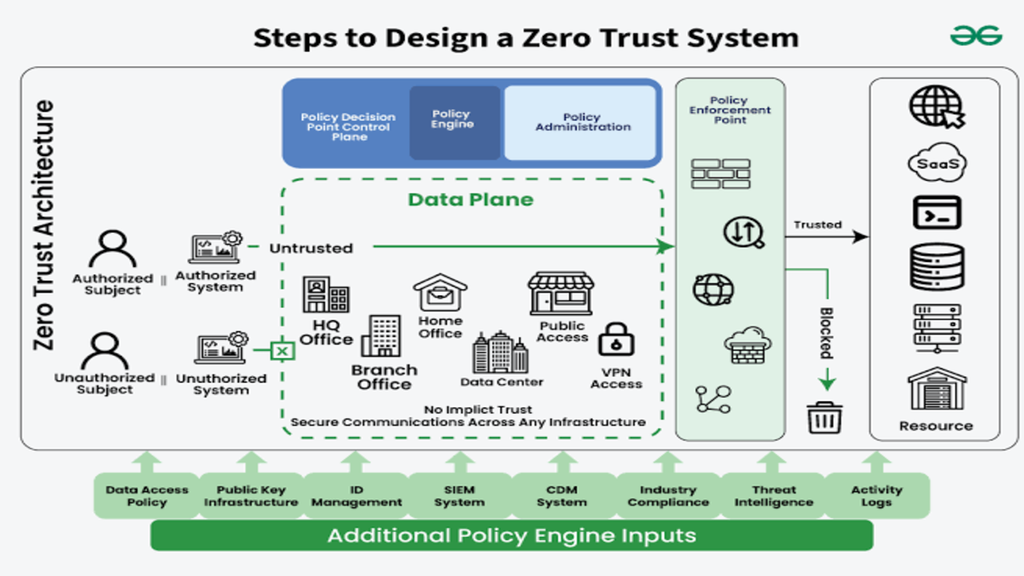
To survive in this expanded threat environment, enterprises are abandoning the castle-and-moat model in favor of a fundamental security paradigm: Zero Trust Architecture (ZTA). Guided by the core principle “never trust, always verify,” Zero Trust treats every access request—whether originating from an executive laptop inside a corporate headquarters or an automated cloud service in a remote datacenter—as an unverified threat.
Rethinking security for the hybrid era is no longer merely a technical upgrade; it is a strategic imperative that redefines how organizations manage risk, protect intellectual property, and maintain operational resilience.
The Core Foundations of Zero Trust
The concept of Zero Trust, formalized by the National Institute of Standards and Technology (NIST) in its SP 800-207 guidelines, represents a shift from location-based security to data- and identity-centric security. Rather than granting access based on where a user is located, Zero Trust evaluates who is asking, what device they are using, what data they are attempting to access, and what contextual risk factors surround the request.
This architectural shift rests on three immutable principles:
1. Explicit Verification
Every access request must be explicitly authenticated and authorized before granting access to any network resource. Authentication relies on multiple data points, including user identity, physical location, device health, service or workload context, firmware versions, and real-time threat intelligence. No session, device, or user is granted persistent trust simply because they previously passed a security checkpoint.
2. Least-Privilege Access
Users and automated applications are granted only the minimum level of access required to perform their immediate, specific tasks—a concept known as Just-In-Time (JIT) and Just-Enough-Access (JEA). By restricting broad administrative privileges and eliminating default open network access, organizations prevent individual compromised credentials from exposing entire enterprise databases.
3. Assume Breach
Zero Trust operates under the premise that malicious actors are already present within the network environment. Security teams design systems to minimize the “blast radius” of a potential compromise. This involves micro-segmenting networks, encrypting all data both in transit and at rest, utilizing continuous behavioral telemetry, and deploying automated response systems to isolate anomalous activity instantly.
Driving Forces in the Hybrid Work Environment
The rapid transition to Zero Trust has been accelerated by severe operational friction within hybrid work environments. As organizations permanently adopted flexible working models, traditional security infrastructure buckled under the weight of modern threat vectors.
The Collapse of Traditional VPNs
For years, the Virtual Private Network was the standard method for remote employee access. However, VPNs were designed for an era when remote workers were an exception rather than the majority. In a hybrid enterprise, routing thousands of remote employees’ encrypted internet traffic back through a central corporate datacenter creates severe network latency, degrades software performance, and costs millions in bandwidth expansion.
More critically, VPNs represent a catastrophic security risk in a hybrid setup. A standard VPN provides full network-level access upon successful login. If a hybrid employee’s personal device is compromised by malware or their credentials are stolen through a targeted phishing attack, an adversary using the VPN gains an authenticated, direct pathway into the core corporate network.
Evasive Attack Tactics and Credential Exploitation
Modern cybercriminals have adapted their strategies to exploit the blind spots of hybrid work environments. Rather than attempting to crack complex firewall encryption, threat actors harvest legitimate user credentials through sophisticated phishing, session hijacking, and social engineering.
Once inside a traditional network using valid credentials, attackers deploy “Living off the Land” (LotL) tactics—abusing native system tools like PowerShell and Remote Desktop Protocol (RDP) to navigate internal systems without dropping identifiable malware files. To a traditional security monitor, an attacker using legitimate credentials and native tools looks identical to a standard remote worker performing daily duties. Zero Trust neutralizes this advantage by continuously evaluating behavior, flagging unusual data queries or lateral movement even if the initial login was verified.
Complex Multi-Cloud and SaaS Supply Chains
Modern enterprises rarely rely on a single software vendor or private server. Corporate workflows are distributed across public clouds, specialized SaaS applications, and third-party vendor integrations. Each external connection, API endpoint, and cloud integration represents an expanded entry point for supply chain attacks. Zero Trust extends identity verification across all environments, ensuring that third-party vendors and automated cloud services are subjected to the same rigorous access controls as internal staff.
Key Components of a Zero Trust Architecture
Implementing Zero Trust requires integrating several advanced security technologies into a unified, interoperable framework. While vendors frequently market standalone “Zero Trust tools,” true Zero Trust is an architectural framework built upon four technical layers:
Identity as the Primary Perimeter
In a hybrid world where physical office boundaries no longer exist, digital identity becomes the definitive security perimeter. Advanced Identity and Access Management (IAM) systems serve as the foundation of Zero Trust.
Organizations utilize modern Identity Providers (IdP) enforcing strong, passwordless Multi-Factor Authentication (MFA)—such as FIDO2 hardware keys and biometric verification—to prevent credential theft. Identity platforms continuously monitor authentication risk, automatically forcing additional verification if an employee attempts to log in from an unrecognized geographic location or an unmanaged device.
Micro-Segmentation
Traditional networks are flat: once inside, a user can navigate freely between HR databases, financial systems, and engineering repositories. Micro-segmentation breaks the network into tiny, isolated security zones around specific workloads, applications, or data sets.
By applying strict granular access policies at the application level, micro-segmentation ensures that even if an attacker compromises a web server in one segment, they are strictly blocked from accessing financial databases or identity servers located in adjacent segments.
Secure Access Service Edge (SASE) and Security Service Edge (SSE)
To secure remote connections without routing traffic through central datacenters, enterprises deploy SASE and SSE architectures. Delivered entirely as cloud-native services, SASE combines software-defined networking with advanced security functions—such as Zero Trust Network Access (ZTNA), Cloud Access Security Brokers (CASB), and Secure Web Gateways (SWG).
ZTNA replaces legacy VPNs by establishing direct, encrypted app-to-app connections. Rather than connecting a remote user to the entire corporate network, ZTNA connects the user exclusively to the specific application they are authorized to use, keeping the rest of the internal network completely invisible to the user’s device.
Continuous Adaptive Risk and Trust Assessment (CARTA)
Zero Trust discards the concept of a “one-time authentication.” Instead, security engines perform continuous telemetry monitoring throughout an active user session.
Utilizing machine learning and User and Entity Behavior Analytics (UEBA), the architecture continuously evaluates behavioral risk scores. If a finance manager who normally downloads three spreadsheets a day suddenly attempts to export thousands of customer records in the middle of the night, the Zero Trust engine automatically revokes the session, isolates the device, and prompts the security operations team.
Access Request (User, Device, Context)
                  ↓
       Identity & Risk Engine
  (MFA, Device Health, UEBA Telemetry)
                  ↓
       Policy Enforcement Point
 (ZTNA / Micro-Segmentation / Least Privilege)
                  ↓
  Isolated, Encrypted Application Session
Overcoming Implementation Challenges and Cultural Friction
While the strategic value of Zero Trust is undisputed, migrating a complex enterprise from legacy infrastructure to a Zero Trust architecture presents significant operational, financial, and cultural hurdles.
Managing Legacy Technical Debt
The most significant obstacle facing established enterprises is legacy technical debt. Older mainframes, proprietary industrial control systems (ICS), and legacy on-premises applications were designed decades ago with implicit trust assumptions. Many of these legacy systems do not support modern single sign-on (SSO) protocols, SAML/OIDC authentication, or granular micro-segmentation.
Overcoming this gap requires deploying hybrid proxy layers and identity-aware gateways that wrap legacy systems in an abstraction layer, allowing modern Zero Trust engines to enforce access policies without requiring complete software overhauls.
Minimizing User Experience (UX) Friction
A poorly designed Zero Trust implementation risks creating intense friction for everyday employees. If workers are forced to complete repetitive, intrusive MFA prompts every twenty minutes or encounter continuous access blocks while attempting routine tasks, productivity plummets.
More dangerously, excessive security friction drives employees toward “Shadow IT”—using unsanctioned personal devices, commercial cloud storage, and unmonitored messaging tools to bypass corporate controls entirely. Successful Zero Trust deployments rely on risk-based, frictionless authentication: utilizing background telemetry, device health checks, and biometric authentication to verify identity silently, prompting active user intervention only when risk scores spike.
Operational Complexity and Skills Shortages
Re-architecting an enterprise network demands deep cross-functional expertise across identity management, cloud engineering, network design, and threat intelligence. A shortage of specialized cloud security engineers means many organizations struggle to configure complex micro-segmentation policies correctly. Overly permissive policies render Zero Trust ineffective, while overly restrictive policies accidentally disrupt business-critical operations.
Regulatory Imperatives and Governance Standards
The transition toward Zero Trust has moved from a corporate best practice to a strict regulatory requirement enforced by governments and international standards bodies worldwide.
In the United States, Executive Order 14028 mandated the adoption of Zero Trust Architecture across all federal civilian agencies, establishing aggressive timelines for implementing MFA, micro-segmentation, and cloud-native security controls. This federal mandate established a baseline standard that private sector contractors, financial institutions, and critical infrastructure operators have rapidly adopted to maintain regulatory compliance.
Similarly, the European Union’s NIS2 Directive and Cyber Resilience Act impose stringent legal duties on essential and important entities to implement rigorous supply chain risk management, continuous identity verification, and advanced encryption protocols. Failure to enforce adequate access governance carries severe financial penalties, with fines reaching up to 10 million euros or 2 percent of global annual turnover.
To track Zero Trust implementation progress, corporate boards and chief information security officers (CISOs) rely on measurable resiliency metrics:
| Resiliency Metric | Legacy Perimeter Model | Zero Trust Architecture Target |
| Network Visibility | Limited to centralized datacenter choke points. | Complete end-to-end telemetry across identity, endpoints, cloud, and networks. |
| Access Permissioning | Broad, network-wide access granted upon initial authentication. | Granular, app-specific access granted dynamically per request (Least Privilege). |
| Average Dwell Time | Months (attackers navigate internal networks unnoticed). | Minutes to hours (anomalous lateral movement is blocked automatically). |
| Blast Radius | High (compromised endpoint exposes whole network). | Isolated (compromise contained within micro-segmented zone). |
| Remote Access Model | High-latency, full-access legacy VPNs. | Cloud-native, zero-trust network access (ZTNA). |
The Future of Zero Trust: AI Integration and Quantum Preparedness
As Zero Trust Architecture matures, its development is intersecting with two transformative technological shifts: artificial intelligence and quantum computing.
The integration of artificial intelligence into Zero Trust engines enables predictive threat containment. Modern Zero Trust platforms utilize automated reasoning to evaluate billions of contextual data points in milliseconds—predicting potential compromise paths, automatically adjusting access policies based on emerging global threat intelligence, and deploying micro-segmentation rules dynamically in response to novel zero-day vulnerabilities.
Simultaneously, the impending arrival of utility-scale quantum computing presents an existential threat to current digital encryption standards. Because quantum processors will eventually be capable of cracking conventional public-key cryptography, Zero Trust architectures are incorporating Post-Quantum Cryptography (PQC). Upgrading identity management, TLS tunnels, and micro-segmentation protocols to quantum-resistant mathematical algorithms ensures that encrypted enterprise data remains protected against long-term “harvest now, decrypt later” attack strategies.
The Journey to Resilient Security
Zero Trust is not a single product that can be purchased, nor is it a project with a final completion date. It is an evolving operational philosophy that replaces dangerous assumptions of implicit trust with continuous, data-driven verification.
In the hybrid era, where work is an activity rather than a physical location, the enterprises that thrive will be those that align their security architectures with operational reality. By committing to Zero Trust Architecture—securing digital identities, enforcing least-privilege access, segmenting critical networks, and assuming breach—organizations eliminate the fatal blind spots of the legacy perimeter.
In doing so, enterprises transform security from a defensive, restrictive burden into a strategic enabler of business agility, innovation, and long-term digital resilience.