







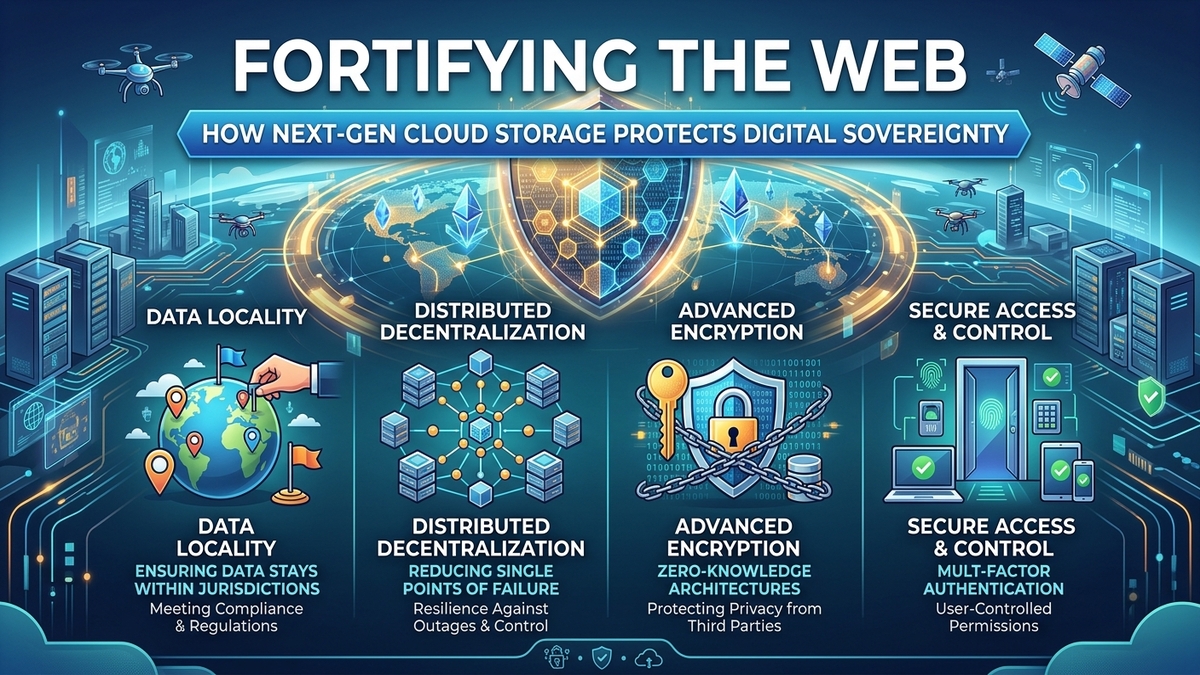
For the better part of three decades, the promise of the public cloud rested on a compelling, boundaryless vision: data would float seamlessly across global networks, stored in whichever datacenter offered the highest efficiency and lowest latency, completely untethered from physical geography. That borderless ideal has officially come to an end.
Driven by escalating geopolitical rivalries, aggressive regulatory mandates, and the explosive growth of data-hungry artificial intelligence systems, the digital world is undergoing a profound structural realignment. National governments and enterprise leadership no longer view the public cloud as a neutral utility. Instead, digital infrastructure is increasingly recognized as a core pillar of national security, economic independence, and corporate survival.
At the center of this transformation is the concept of digital sovereignty—the ability of nations, enterprises, and citizens to maintain absolute legal, operational, and technical control over their digital assets. In response, a new technical paradigm has emerged: next-generation sovereign cloud storage. Combining hardware-enforced confidential computing, zero-knowledge encryption, air-gapped regional nodes, and strict local governance, this next-era storage architecture is rebuilding the foundation of the global internet, offering a blueprint for how data can remain protected in an increasingly fragmented world.
The Death of the Boundaryless Cloud
The migration of global commerce to hyperscale public cloud providers was one of the most significant economic accelerations in modern history. However, it also created an unprecedented structural vulnerability. Three major American technology companies currently host the vast majority of Western enterprise and public sector data. This concentration of digital power meant that a decision made in a foreign courtroom or a shift in international trade policy could instantly impact the data security and legal compliance of sovereign nations thousands of miles away.
The tension reached a breaking point due to conflicting extraterritorial laws. Legislation such as the U.S. CLOUD Act granted American law enforcement agencies the potential authority to compel U.S.-based technology firms to hand over data stored on servers overseas, regardless of local privacy laws. For European governments, financial institutions, and healthcare providers governed by strict privacy mandates like the General Data Protection Regulation (GDPR), this cross-border legal exposure presented an existential risk.
Concurrently, high-profile cyber warfare incidents, supply chain disruptions, and the weaponization of trade restrictions demonstrated that physical and digital infrastructure are inseparable. A country that relies entirely on foreign-owned and foreign-operated servers to store its health records, power grid schematics, and financial ledgers possesses only nominal independence. As a result, the mandate to decouple critical digital assets from foreign jurisdiction has shifted from an academic debate among policy experts into an urgent priority for corporate boards and national defense ministries alike.
From Regulatory Compliance to Strategic Prerequisite
In the early stages of the digital sovereignty movement, corporate participation was largely defensive. Organizations viewed localization mandates as administrative hurdles—box-checking exercises required to satisfy regional regulators and avoid punitive fines.
That reactive posture has evaporated. Recent global studies across enterprise technology sectors indicate that data sovereignty has evolved from a legal compliance requirement into a strategic prerequisite for digital transformation.The primary driver is no longer merely the fear of regulatory penalties, but a broader recognition of operational risk.
Enterprises are increasingly concerned by three major risk factors:
- Foreign Legal Overreach: The threat of foreign intelligence agencies or courts seizing proprietary trade secrets, customer records, or financial data without local judicial review.
- Vendor Lock-In and Cloud Vulnerability: The operational danger of relying on a single foreign provider that could alter terms of service, raise prices, or suffer service interruptions due to geopolitical sanctions.
- Protection of Proprietary Intellectual Property: The imperative to prevent proprietary datasets—particularly those used to train enterprise artificial intelligence models—from leaking into shared public cloud environments.
This risk-driven mindset has catalyzed a massive reallocation of enterprise technology spending. The global market for sovereign cloud infrastructure has experienced double-digit annual growth, driven largely by financial services, healthcare organizations, and public sector agencies moving core workloads away from traditional, unconstrained public cloud pools into localized, sovereign environments.
The Technological Architecture of Next-Gen Sovereign Storage
Next-generation sovereign cloud storage is not simply traditional cloud hardware enclosed by a physical fence. It represents a fundamental redesign of software, hardware, and operational protocols designed to guarantee that data remains under the exclusive control of its owner, regardless of where the physical servers reside.
Several core technological breakthroughs define this new architecture:
Hardware-Enforced Confidential Computing and Local Key Management
Historically, data in the cloud was encrypted while stored on disk (at rest) and while moving across networks (in transit). However, to process or search that data, it had to be decrypted in the server’s memory (in use), leaving it briefly vulnerable to hypervisor breaches or administrative subpoenas. Next-generation storage utilizes confidential computing, leveraging specialized hardware-based Trusted Execution Environments (TEEs) built directly into modern server microprocessors. Data remains fully encrypted even while actively being processed in memory.
Crucially, cryptographic keys are managed through External Key Management (EKM) systems located entirely within the customer’s physical jurisdiction.Under this architecture, even if a cloud provider is served with a court order, they physically lack the technical capability to decrypt or access the customer’s data.
Air-Gapped and Isolated Sovereign Nodes
For national defense, critical infrastructure, and highly classified public sector operations, connected public clouds present unacceptable attack surfaces. Next-gen storage architectures deploy fully isolated, air-gapped sovereign nodes.These data platforms run on-premises or within specialized regional datacenters, completely disconnected from the public internet. They operate independently without requiring remote telemetry or management updates from foreign headquarters, ensuring operational survival even if global submarine internet cables are severed or international communications networks are shut down.
Local Operating Partner Models
To reconcile the technical capabilities of global hyperscalers with strict national sovereignty demands, a new operational framework has gained widespread adoption: the local operating partner model. Major cloud providers partner with independent, domestically owned technology companies within a specific nation. The local partner owns, operates, and maintains the physical datacenter infrastructure, while foreign engineers are legally and technically barred from administrative access. This ensures that the infrastructure complies fully with local security standards—such as France’s SecNumCloud or Germany’s IT-Grundschutz—while retaining the advanced computing features of modern cloud platforms.
Immutable and Cryptographically Verifiable Storage
Addressing the rise of sophisticated ransomware and state-sponsored data manipulation, next-generation storage integrates immutable object locking and cryptographic proofs of retrievability.Stored data snapshots cannot be altered, overwritten, or deleted by any user—including system administrators—for a predefined retention period. Combined with continuous cryptographic auditing, organizations can instantly verify that stored data has not been secretly modified or accessed by unauthorized third parties.
The European Regulatory Blueprint and Global Ripple Effects
Europe has consistently served as the regulatory epicenter of the digital sovereignty movement, setting enforcement precedents that are rapidly reshaping global technology architectures.A wave of sweeping European digital legislation has fundamentally altered the rules of cloud operations.
The European Union’s Data Act enforces strict cloud switching rights, legally requiring infrastructure providers to remove technical and financial barriers that previously locked enterprises into proprietary ecosystems.Cloud customers now possess explicit legal protections allowing them to migrate data and workloads seamlessly between local and international providers without exorbitant egress fees.
Concurrently, the enforcement of the NIS2 Directive and the Digital Operational Resilience Act (DORA) has placed direct legal accountability on corporate management boards for supply chain cybersecurity and infrastructure resilience.In the financial sector, DORA grants European regulators direct supervisory authority over critical cloud providers, mandating that financial institutions maintain verified exit strategies and operational redundancy within sovereign borders.
This regulatory philosophy is no longer confined to Europe. Nations across North America, Latin America, the Middle East, and the Asia-Pacific region are establishing localized data residency requirements, mandating that citizen health records, financial transactions, and government data remain strictly within national borders. As a result, multinational corporations operating globally must abandon single, centralized cloud strategies in favor of highly distributed, multi-sovereign architectures capable of adapting to local legal frameworks.
Sovereign AI and the Training Data Bottleneck
The urgency surrounding digital sovereignty has been dramatically heightened by the global race for artificial intelligence. Generative AI systems and large language models require vast repositories of data for training and fine-tuning. However, feeding sensitive corporate intellectual property, medical records, or strategic national data into centralized, foreign-hosted AI platforms creates an unprecedented data leakage vector.
This reality has given birth to the concept of Sovereign AI—the principle that a nation or organization must possess domestic control over the compute infrastructure, training datasets, and algorithmic models that power its AI systems.
Next-generation sovereign storage provides the essential bedrock for Sovereign AI. By embedding high-performance storage arrays within sovereign data boundaries, organizations can run complex AI training and inference workloads locally. Proprietary data never leaves the controlled regional environment, ensuring that model weights and sensitive insights remain strictly protected under local legal protections.
Raw Regional Data Stream
        ↓
Local Sovereign Storage Array (Confidential Computing)
        ↓
Isolated Local Compute Cluster (Air-Gapped / Sovereign AI)
        ↓
Protected Regional Intelligence (Zero Foreign Data Egress)
From healthcare networks training diagnostic models on patient records to sovereign wealth funds running predictive financial algorithms, sovereign storage ensures that the economic value created by data accrues locally rather than being extracted by foreign technology platforms.
The Economic and Philosophical Trade-Offs
While the security and compliance benefits of next-generation sovereign storage are clear, the movement is not without significant economic and technical friction. Transitioning from a single, unified global cloud to a patchwork of sovereign nodes introduces real costs and operational complexities that organizations must navigate carefully.
The most immediate challenge is the loss of pure hyperscale economies of scale. Fragmenting infrastructure across multiple regional datacenters often leads to higher operational overhead, duplicate software licensing, and increased capital expenditures. Furthermore, enterprise IT departments face acute personnel shortages, struggling to recruit specialized talent capable of managing complex, multi-jurisdictional key management frameworks and sovereign compliance architectures.
From a broader philosophical perspective, critics warn that the relentless drive toward digital sovereignty risks accelerating the fragmentation of the global web—a phenomenon frequently termed the “Splinternet.” If every nation enforces rigid digital borders, the open, collaborative spirit that fueled the initial explosion of internet innovation could be replaced by isolated, regional digital walled gardens.
Proponents of sovereign cloud, however, argue that the opposite is true. They maintain that without robust, enforceable digital boundaries that protect human rights and national security, public trust in the internet will collapse entirely. In this view, next-generation sovereign storage does not destroy global connectivity; rather, it provides the necessary trust architecture that allows nations and enterprises to participate in global digital commerce without sacrificing their autonomy or safety.
Navigating the Sovereign Future
The era of uncritical digital globalization has yielded to a pragmatic, security-first reality. The public cloud is no longer viewed as an abstract, borderless sky, but as a physical, highly regulated infrastructure rooted in specific soils, governed by specific laws, and defended by specific technologies.
Next-generation cloud storage stands at the core of this new world order. By combining sophisticated hardware encryption, sovereign operational partnerships, local AI infrastructure, and strict policy governance, next-gen storage delivers a viable path forward. It allows society to harness the immense computational power of modern cloud technologies while guaranteeing that data—the primary strategic asset of the modern age—remains firmly in the hands of those who create it.
For corporate executives, technology architects, and policymakers, the imperative is clear: digital sovereignty can no longer be treated as a secondary IT consideration. The organizations and nations that successfully fortify their digital infrastructure today will define the rules of competition, resilience, and independence in the connected world of tomorrow.