







Every morning, millions of people worldwide are nudged awake by smart alarms that tracked their sleep stages through microscopic movement sensors. Within seconds, a voice assistant reads the daily weather forecast, a connected thermostat adjusts the indoor climate based on learned routine, and a wrist-worn health tracker records resting heart rate, oxygen saturation, and body temperature. Before an individual has even stepped out of bed, dozens of discrete data points have been logged, encrypted, transmitted, and analyzed across distant cloud servers.
This seamless automation represents the pinnacle of modern technological convenience. Yet, if you ask those same individuals whether they are concerned about their personal data privacy, a striking majority will express deep alarm. Survey after survey conducted across North America, Europe, and Asia reveals that upward of 80 percent of consumers report feeling anxious about corporate surveillance, location tracking, and the monetization of their private lives.
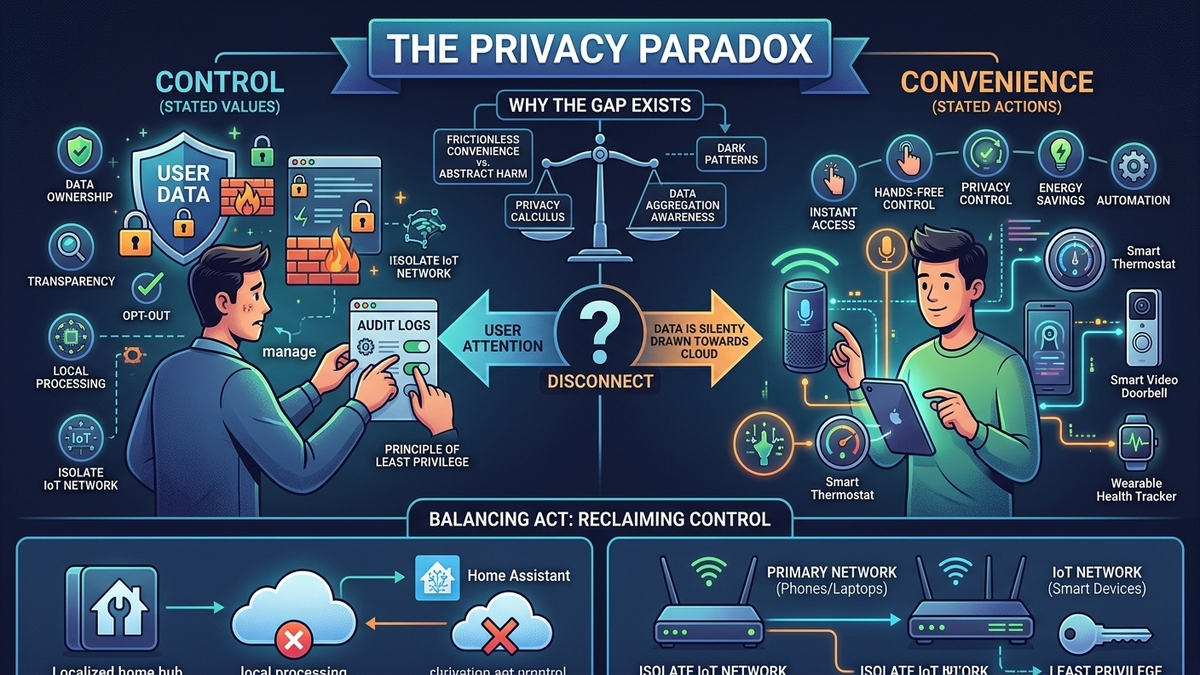
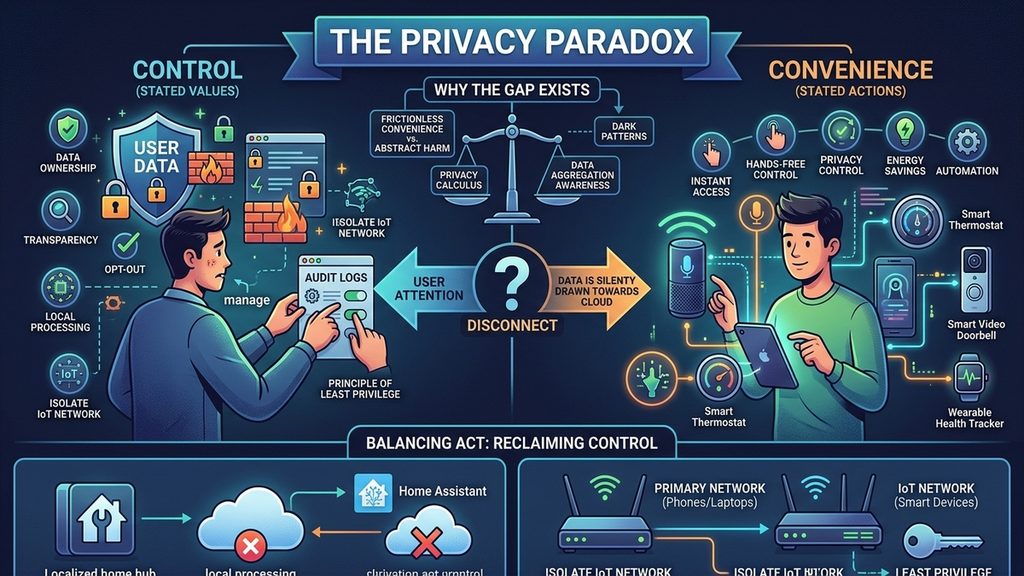
This disconnect defines one of the most significant socio-technical phenomena of the twenty-first century: the Privacy Paradox. First identified by behavioral economists and academic researchers, the paradox describes the stark contradiction between people’s stated intentions regarding data protection and their actual behavior. While individuals routinely declare that privacy is a fundamental right, their daily choices tell a different story. They eagerly trade precise biometric data, real-time location telemetry, and intimate domestic audio for minor friction reductions—a voice-activated light switch, a recommended music playlist, or an automated grocery order.
As smart devices evolve from discrete home gadgets into an ambient, continuous computing layer embedded within physical spaces, the privacy paradox has intensified. Understanding this dynamic requires examining the psychological triggers that drive consumer choices, the economic machinery powering the smart device ecosystem, the structural failure of traditional consent models, and the emerging technical architectures aiming to restore digital sovereignty.
The Architecture of Ambient Data Extraction
To understand why the privacy paradox has become so pervasive, one must first look at the technical evolution of the smart device landscape. The consumer technology market has migrated far beyond the era of explicit digital interactions. A decade ago, data collection required active participation: a user opened a web browser, typed a search query, or checked in at a specific physical location on a smartphone app.
Today’s smart ecosystem operates on a model of passive, ambient extraction. Modern homes, vehicles, and workplaces are outfitted with multi-sensor arrays designed to operate continuously in the background:
- Voice Platforms and Far-Field Audio: Smart speakers and television remotes utilize far-field microphone arrays running low-power wake-word detection chips. While manufacturers maintain that audio is only recorded after a trigger phrase is uttered, local buffering continuously captures short snippets of ambient room sound to detect commands, acoustic anomalies, or background noise profiles.
- Spatial Perception and Environmental Sensors: Connected security cameras, robot vacuums, and smart displays rely on high-definition optical lenses, infrared sensors, and millimeter-wave radar to map physical spaces. These devices catalog room dimensions, furniture layouts, and movement patterns, transforming the interior of a private home into structured spatial data.
- Biometrics and Continuous Telemetry: Wearables and smart rings monitor physiological metrics 24 hours a day. Photoplethysmography (PPG) sensors measure blood volume changes, electrodermal activity sensors track stress responses, and continuous GPS tracks physical velocity and location down to the meter.
When these disparate hardware nodes are linked under a single cloud account, they produce a rich, high-resolution picture of human behavior. The data collected is rarely limited to the immediate task at hand. A smart thermostat does not merely record temperature preference; it infers household occupancy schedules, sleep patterns, and economic status based on energy consumption profiles. A smart television does not simply display content; through Automatic Content Recognition (ACR) technology, it logs every frame passing across the screen—including video games, broadcast news, and home videos—to construct a detailed profile of media consumption habits.
This continuous background harvesting lowers the visibility of data extraction. Because the interaction requires no conscious effort from the user, the exchange of personal information occurs quietly, away from the user’s immediate attention.
The Psychological Engine of the Paradox
Why do consumers so readily accept this level of ambient monitoring despite expressing explicit privacy concerns? The answer lies in the cognitive biases that govern human decision-making and behavioral economics.
At the center of the privacy paradox is the concept of hyperbolic discounting. Human psychology naturally prioritizes immediate, tangible rewards over distant, abstract risks. When a consumer purchases a smart lock or a voice-controlled appliance, the convenience is immediate, visible, and tangible: the door unlocks as they approach with groceries, or the lights dim with a simple verbal command.
In contrast, the privacy risks associated with that device are invisible, deferred, and probabilistic. The potential harms—such as an opaque data broker compiling a behavioral profile, a future insurance provider adjusting premiums based on activity telemetry, or a cloud server suffering a database breach three years down the line—feel speculative and remote. Faced with a choice between instant operational convenience and an abstract future risk, cognitive processing consistently favors immediate gratification.
This psychological dynamic is further amplified by asymmetric information and learned helplessness. The modern digital ecosystem is intentionally complex. The average consumer possesses neither the technical expertise nor the time required to audit how data flows from an internet-of-things (IoT) device through third-party software development kits (SDKs) to advertising exchanges.
Furthermore, as smart devices become standard infrastructure in home appliances, automobiles, and public facilities, consumers increasingly feel that opt-out options are illusory. When operating without a smartphone or a connected device makes participating in modern society difficult, individuals experience a sense of resignation. They convince themselves that “privacy is dead anyway,” rationalizing their surrender of personal data as an inevitable tax of living in a connected world.
Corporate user interface designers frequently capitalize on these psychological vulnerabilities through “dark patterns”—deceptive interface designs that nudge users toward privacy-invasive choices. Opt-in tracking prompts are highlighted with vibrant, appealing buttons, while opt-out options are buried deep within multi-layered settings menus, obscured behind technical jargon, or framed with alarming warnings that opting out will degrade device functionality.
The Business Model of Frictionless Living
The privacy paradox is not merely an accidental byproduct of consumer psychology; it is the economic engine of the consumer hardware industry. The financial models driving the smart device revolution explain why powerful computing hardware is often sold to consumers at remarkably low price points.
In the early decades of consumer electronics, hardware manufacturers operated on a traditional transactional model: a company built a physical device, sold it for a profit margin above manufacturing costs, and the transaction concluded at the point of sale.
The rise of cloud computing and algorithmic advertising transformed this paradigm into what academic researchers term “surveillance capitalism.” In this business model, physical hardware frequently serves as a subsidized delivery mechanism for data collection infrastructure. A smart speaker sold for $30 or a high-definition smart television sold near cost is not the primary source of long-term profit. Instead, the true commercial value lies in the downstream data pipeline unlocked by placing a connected sensor array inside a consumer’s living room.
Once harvested, device telemetry fuels an extensive, multi-billion-dollar data broker ecosystem. Aggregated data points are combined across disparate sources—credit card transactions, location records, browsing histories, and smart device telemetry—to build highly detailed digital profiles. These profiles are then monetized across several commercial channels:
- Hyper-Targeted Advertising: Behavioral data enables advertisers to target consumers based not just on demographic categories, but on psychological states, real-time locations, and daily routines.
- Algorithmic Dynamic Pricing: E-commerce platforms and travel booking services utilize location data, device models, and purchasing history to dynamically adjust product prices based on an individual’s estimated price sensitivity.
- Risk Modeling and Financial Underwriting: Insurance carriers and financial institutions increasingly look to alternative data streams—such as driving telemetry from connected vehicles or health metrics from wearables—to assess risk profiles, adjust premiums, and evaluate creditworthiness.
This economic reality creates a fundamental misalignment of incentives. While consumers buy smart devices to make their lives easier, hardware manufacturers and platform operators are economically incentivized to maximize data extraction. The frictionless convenience offered to the consumer is the exact mechanism required to ensure continuous, uninterrupted data flow back to central corporate repositories.
Regulatory Deficits and the Illusion of Choice
In response to growing public concern over data exploitation, governments around the world have enacted comprehensive privacy legislation. Frameworks such as the European Union’s General Data Protection Regulation (GDPR), the California Consumer Privacy Act (CCPA), and emerging data protection statutes across Asia and South America were designed to restore user control by establishing clear rights to data access, deletion, and consent.
However, in the context of the smart device age, the legal framework governing data protection faces severe operational limitations. Traditional privacy law rests heavily on the notice-and-consent paradigm—the idea that as long as an organization provides a disclosure of its data practices and obtains user agreement, consumer rights are protected.
In practice, the notice-and-consent model has collapsed under the weight of its own complexity, creating what legal scholars call the “illusion of choice.”
A study examining online privacy policies calculated that if an average individual were to actually read every privacy policy for every service and connected device they used in a year, it would take over 200 full working hours. Smart device End User License Agreements (EULAs) are notoriously lengthy, written in dense legal terminology, and updated continuously without meaningful notice.
Furthermore, consent in the smart device ecosystem is rarely truly voluntary. Unlike opting out of a website newsletter, refusing to accept the privacy terms of a smart thermostat, connected car, or medical wearable often renders the hardware completely inoperable. Consumers are presented with a binary choice: accept total data harvesting or forfeit the functional utility of an expensive physical device they have purchased.
This legal fiction is even more pronounced in multi-user household environments. When a smart speaker or connected security camera is installed in a home, it collects data on family members, guests, children, and visitors who never had the opportunity to read a privacy policy or click “I Agree.” The ambient nature of modern IoT technology bypasses the foundational mechanics of individual consent entirely, exposing the gap between static legal regulations and the dynamic reality of modern data tracking.
Reclaiming Sovereignty: Technical Defenses and Future Architecture
As the limitations of regulatory frameworks become apparent, privacy advocates, software engineers, and hardware architects are working to resolve the privacy paradox through technical design. Rather than relying on consumers to continuously alter their behavior or trusting corporations to self-regulate, the goal is to build privacy directly into the technical architecture of smart computing—a concept known as Privacy by Design.
The most critical architectural shift is the movement away from cloud-dependent processing toward local edge computing.
In traditional smart device setups, raw sensory data—such as audio recordings or camera feeds—is streamed across the internet to hyperscale corporate datacenters, where cloud algorithms process the data and send a response back to the device. This architecture creates massive central honeypots of personal data vulnerable to interception, subpoena, and internal misuse.
Edge computing reverses this flow by performing data processing directly on the device itself. Powered by specialized, high-efficiency Neural Processing Units (NPUs) and compact language models, modern smart hardware can perform real-time voice recognition, computer vision, and predictive automation locally, without transmitting raw personal data over the internet.
Key technical innovations reshaping the privacy landscape include:
- Local-First Smart Home Platforms: Open-source automation frameworks allow users to connect smart sensors, lighting, and climate systems to a local home hub isolated from external vendor clouds. Commands are processed within the local local-area network (LAN), ensuring that domestic routines remain entirely private.
- Hardware-Level Privacy Controls: Device manufacturers are increasingly incorporating physical, hardwired disconnect switches for microphones and camera lenses. Unlike software toggles, which can be bypassed by software vulnerabilities, physical kill switches physically sever power to sensor circuits, offering verifiable privacy assurance.
- Differential Privacy and Federated Learning: When device manufacturers require user data to train machine learning models, advanced cryptographic techniques are deployed. Federated learning allows models to learn from decentralized device data locally, sending only mathematical model updates back to central servers. Differential privacy adds mathematical noise to these updates, ensuring that individual user data cannot be reconstructed or back-engineered.
- Standardized Interoperability Protocols: Emerging universal connectivity standards, such as Matter, aim to reduce reliance on proprietary, vendor-locked cloud ecosystems. By establishing secure, local device-to-device communication standards, these protocols enable smart devices from different manufacturers to interact safely across local networks.
By embedding privacy protections into the fundamental software and hardware layers, these technical developments aim to dismantle the privacy paradox. They offer a future where consumers no longer have to make a punitive choice between technological convenience and personal autonomy.
Beyond the Illusion of Control
The privacy paradox is not a failure of individual willpower; it is the predictable outcome of an ecosystem engineered to capitalize on cognitive vulnerabilities, asymmetric information, and economic incentives that prioritize data extraction above all else. Asking individual consumers to manually safeguard their personal data while navigating a world woven with ambient sensors is an unreasonable expectation.
Resolving this tension requires a fundamental shift in how society approaches technology design, policy enforcement, and corporate accountability. Privacy can no longer be treated as a luxury good or a complex setting buried deep within an options menu. It must be recognized as a baseline structural requirement—as essential to consumer safety as electrical insulation or structural engineering standards.
As computing continues to recede into the physical background of our homes, cities, and bodies, the trajectory of technological progress must be re-aligned. True innovation does not demand the systematic surrender of private life. The ultimate goal of the smart device age must be to build technology that serves human needs, enhances daily living, and delivers seamless convenience—all while respecting the fundamental dignity of individual privacy and human autonomy.