








For more than fifteen years, the architectural doctrine of modern enterprise technology was simple: centralize everything in the cloud. As global hyperscale data centers expanded across North America, Europe, and Asia, companies migrated their infrastructure away from on-premises servers. The promise of central cloud computing was compelling—unlimited scalable storage, centralized management, cheap compute power, and global accessibility.
That centralizing tide has now reached its physical and economic limits.
We have entered a pivotal transition period where the traditional “cloud-first” model is actively choking under its own operational weight. The sheer volume of raw data generated by internet-of-things (IoT) devices, high-definition camera grids, industrial automation sensors, medical telemetry, and autonomous transport has overwhelmed central networks. At the same to time, the rise of real-time artificial intelligence inference has created an urgent demand for split-second, microsecond decision-making that no distant server farm, regardless of its processing capacity, can deliver.
Industry research reflects this massive structural migration. Analysts estimate the global edge computing market has surged past $25 billion in 2026, heading toward a trajectory expected to exceed $260 billion by the mid-2030s. Estimates from the International Data Corporation (IDC) project global data creation reaching approximately 180 zettabytes, with roughly three-quarters of that information generated entirely outside traditional centralized data centers.
Processing data locally—at the edge of the network, directly on devices or through localized micro data centers—is no longer an experimental optimization. It has become a foundational non-negotiable requirement for modern digital infrastructure.
The Death of Latency Tolerance: Why Speed Is Physics, Not Software
The most immediate catalyst driving data processing back to the local origin is deterministic latency. In computing, latency is the delay between an action being initiated and its corresponding response. For an office worker editing a shared cloud document or sending an email, a round-trip network ping of 100 to 200 milliseconds is completely imperceptible. For a connected machine operating in a critical physical environment, that same delay can lead to cataclysmic failure.
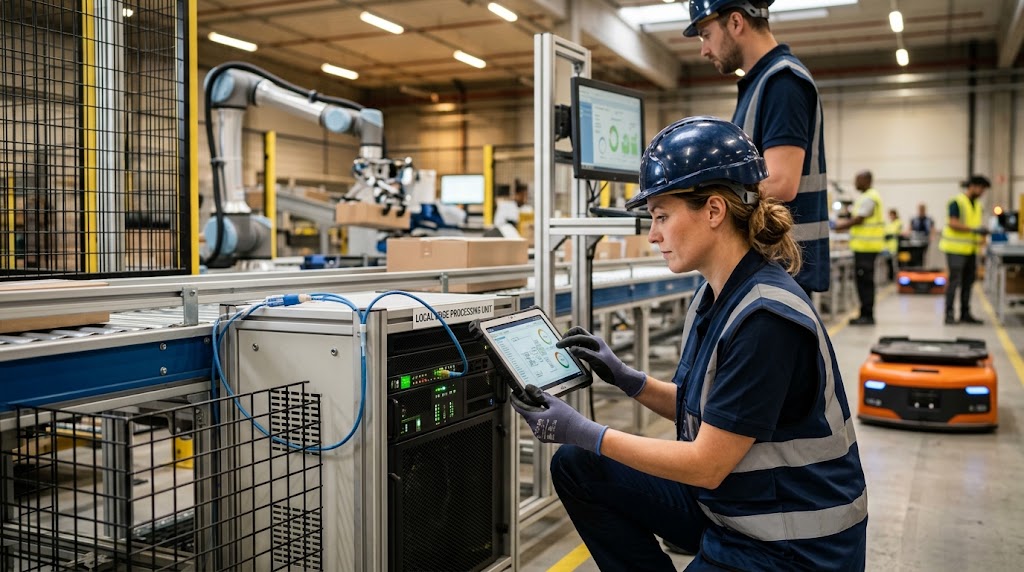
Consider high-speed automated manufacturing lines. A modern computer vision inspection node on a bottle assembly line processes thousands of units per hour. To catch a structural defect or foreign object, the system must capture high-resolution frames, execute neural network inference, and signal an mechanical actuator to reject the defective item within single-digit milliseconds. Sending raw image streams to a cloud region hundreds of miles away—waiting for network routing, queueing, cloud processing, and backhaul transmission—introduces unpredictable latency spikes that render real-time quality control impossible.
Autonomous vehicles present an even starker reality. A self-driving car travelling at highway speeds covers nearly thirty meters every second. Sensor fusion algorithms combining LiDAR, radar, and optical cameras must process surrounding environment telemetry instantly to execute evasive braking or steering maneuvers. Relying on an uninterrupted wireless connection to a distant cloud server to make split-second driving decisions violates fundamental functional safety standards.
When response times must be guaranteed down to sub-millisecond thresholds, network distance is an immovable barrier. Software can be optimized, but the speed of light through fiber-optic cables and radio airwaves remains fixed. Bringing compute power physically closer to the sensor array is the only viable engineering solution.
The Economics of Backhaul: Managing the Zettabyte Deluge
Beyond the physics of speed, the financial reality of network bandwidth has forced enterprise executives to rethink their data architectures.
In the early days of cloud migration, uploading data was seen as virtually frictionless. However, streaming raw continuous telemetry from thousands of enterprise edge endpoints 24 hours a day, 7 days a week creates severe fiscal drag. The vast majority of raw operational data is routine background noise—a steady temperature reading, an unchanged video frame of an empty hallway, or static vibration metrics from a healthy turbine shaft.
Transmitting gigabytes of unfiltered noise over cellular networks or leased commercial lines to cloud storage environments consumes enormous network capacity and inflates backhaul charges. Once inside the cloud, enterprises are hit with secondary fees for ingest, storage, and cross-region egress.
Edge computing fundamentally alters these economics through local data scrubbing, deduplication, and event filtering. By deploying localized edge gateways equipped with multi-core processors and specialized industrial storage, organizations can ingest and analyze telemetry at the point of origin.
The edge system acts as an intelligent filter: it continuously processes raw data locally, detects statistical anomalies or critical events in real time, and transmits only condensed intelligence or critical alerts to central corporate repositories. Industry deployments indicate that scrubbing data at the source can reduce network backhaul costs by as much as 80 percent, turning what would be a multi-million-dollar annual network bill into a controlled, predictable operational expense.
Operational Autonomy: Building Resilient Systems in an Unpredictable World
A central vulnerability of cloud-exclusive architecture is its inherent dependence on constant, uninterrupted connectivity. If a local internet service provider suffers a trunk failure, if an undersea fiber cable is damaged, or if a centralized cloud region experiences a major outage, cloud-dependent operations grind to an immediate halt.
For non-critical applications, a temporary service interruption is an annoyance. For industrial facilities, energy grids, hospitals, and logistics hubs, network downtime represents massive financial loss and severe safety hazards.
Edge computing provides operational autonomy. By embedding localized intelligence and high-endurance storage into local gateways and micro data centers, critical control loops operate independently of external cloud availability.
If an industrial facility loses its primary wide-area network connection, the localized edge gateway continues to orchestrate assembly robotics, log operational telemetry to local storage buffer caches, and enforce safety protocols without interruption. When connectivity is eventually restored, the edge node automatically synchronizes its local state logs with the central cloud system. This architectural design decouples real-time operational continuity from the fragile availability of wide-area communication links.
Data Sovereignty and the New Regulatory Landscape
As digital infrastructure has integrated deeper into global commerce and daily civic life, national governments and international regulatory bodies have enacted strict data protection frameworks. Regulations such as the European Union’s General Data Protection Regulation (GDPR) and various regional health and financial compliance frameworks have erected clear boundaries around where sensitive information can be processed, stored, and moved.
These legal mandates have turned centralized cross-border cloud processing into a legal and regulatory minefield. Transmitting raw customer biometric data, medical diagnostic imagery, or proprietary industrial blueprints to multi-tenant cloud data centers in foreign jurisdictions creates significant exposure to compliance fines and security breaches.
Localized edge computing directly aligns with data sovereignty principles:
- Data Localization: Sensitive raw data remains contained within the physical boundaries of the local facility, city, or sovereign region where it was generated.
- Privacy by Design: Facial recognition systems, medical monitoring wearables, and audio analytics nodes can process video and voice signals locally, instantly discarding raw footage and outputting only anonymous text data or aggregate metrics upstream.
- Minimization of Attack Surfaces: By keeping sensitive databases off centralized, publicly accessible cloud endpoints, organizations eliminate single points of corporate exposure to global cyber threats.
Furthermore, innovations such as federated learning are allowing organizations to advance their machine learning models without compromising privacy. Under federated learning models, distributed edge nodes train local AI software using locally retained data. Instead of sending private raw records back to a central server, the devices share only mathematical model weight updates, which are aggregated globally before being redistributed back to the edge.
The Edge AI Catalyst: How Hardware Silicon Caught Up
The widespread adoption of edge computing would be impossible without a simultaneous revolution in micro-semiconductor design.
For years, sophisticated artificial intelligence inference required massive GPU clusters housed in power-hungry data center racks. Deploying complex neural networks on tiny embedded devices or remote factory gateways was constrained by severe thermal limits, high power consumption, and insufficient processing speed.
That hardware bottleneck has dissolved. Silicon manufacturers have successfully integrated specialized Neural Processing Units (NPUs) and low-power AI accelerators into standard system-on-chip architectures. Modern edge processors deliver trillions of operations per second while drawing only a few watts of power, delivering unprecedented computational efficiency compared to traditional general-purpose CPUs.
Simultaneously, software engineers have refined techniques like model quantization and structural pruning. These methods shrink full-scale neural networks to a fraction of their original memory footprint without sacrificing operational precision. As a result, sophisticated computer vision, natural language understanding, and predictive maintenance models can now run natively on compact, passively cooled hardware deployed on light poles, offshore oil rigs, delivery vehicles, and medical equipment.
The Hybrid Future: Redefining the Role of the Hyperscale Cloud
The aggressive shift toward localized processing does not signal the demise of central cloud providers. Rather, it represents a structural maturation of how enterprise computing resources are deployed across the physical world.
The hyperscale cloud is transitioning from an all-encompassing, real-time brain into a strategic macro-coordination hub. Massive centralized data centers remain unmatched for heavy computational tasks that are not bound by split-second latency—such as training multi-billion-parameter foundation AI models, executing long-term historical data analytics, managing global financial ledgers, and maintaining multi-year archival backups.
In this emerging hybrid architecture, responsibilities are clearly divided:
- The Edge: Handles instant execution, localized real-time inference, high-frequency sensor fusion, immediate safety loops, and privacy filtering at the physical point of action.
- The Central Cloud: Receives scrubbed, aggregated intelligence from thousands of edge nodes to continuously refine global algorithms, manage fleet-wide orchestration, and store macro-level business insights.
Organizations that master this balance are gaining decisive operational advantages. By deploying compute power precisely where it creates the highest value—balancing local immediacy with central analytics—enterprises are building systems that are faster, safer, vastly more cost-efficient, and structurally resilient against network instability.
The debate over whether the cloud or local hardware is superior has officially ended. The physical laws of latency, the fiscal limits of network bandwidth, and the realities of global regulatory compliance have rendered the decision clear: in the modern tech ecosystem, processing data locally is no longer just an alternative strategy—it is a non-negotiable operational imperative.