







For more than a decade, the architectural logic of the digital economy was dictated by scale. Technology giants constructed massive, hyper-centralized data center campuses—windowless megastructures sprawling across hundreds of thousands of square feet in rural Virginia, Oregon, and Northern Europe. These hyperscale facilities offered unprecedented economies of scale, housing millions of servers that processed everything from financial transactions to streamable entertainment.
That centralized topology, however, is reaching a structural barrier. The explosion of localized artificial intelligence, autonomous transportation networks, industrial automation, and real-time streaming services has exposed the physical limits of moving data across vast geographic distances. When an autonomous delivery drone navigates a suburban street, or a surgeon performs a tele-robotic procedure, transmitting raw sensor feeds to a server farm 500 miles away introduces delays that no software optimization can fix.
The tech industry’s response is a dramatic physical redistribution of computational power. Rather than forcing all data to travel to distant hyperscale hubs, infrastructure is moving directly to the end-user.
Welcome to the era of the micro-datacenter: compact, self-contained, and prefabricated compute units deployed inside cell towers, hospital basements, electric vehicle charging stations, suburban retail strips, and municipal utility yards. Valued at approximately $12.6 billion globally in 2026, the micro-datacenter market is projected to expand significantly over the next decade as enterprise IT shifts from centralized cloud monoliths to highly distributed edge networks.
What Is a Micro-Datacenter?
A traditional data center is a civil engineering project requiring years of land acquisition, heavy utility connections, specialized building construction, and bespoke cooling plants. A micro-datacenter, by contrast, is an industrial appliance.
Typically ranging in size from a single server rack (20U to 40U) up to modular, containerized units housing several racks, a micro-datacenter integrates every essential element of enterprise IT infrastructure into a hardened, plug-and-play enclosure:
- Uninterruptible Power Supplies (UPS): Onboard lithium-ion battery banks that buffer against grid fluctuations and maintain continuous uptime.
- Precision Cooling: Closed-loop liquid cooling or direct-expansion air units capable of dissipating high-density thermal loads generated by modern GPU clusters.
- Physical and Environmental Hardening: Tamper-proof steel enclosures equipped with localized fire suppression, ingress protection against dust and moisture, and acoustic dampening for deployment in populated areas.
- Autonomous Remote Monitoring: Sensor arrays coupled with predictive management software that monitor thermal profiles, power draw, and mechanical health without requiring on-site technicians.
Because these units are prefabricated and pre-tested in factory settings, deployment timelines collapse dramatically. While constructing a conventional data center can take two to three years, a micro-datacenter can be delivered, wired, and fully operational in a matter of weeks.
The Primary Drivers Moving Compute to the Edge
The migration toward micro-datacenters is not a replacement for central cloud providers, but an essential extension of them. Three primary technological and economic forces are accelerating this architectural shift.
1. The Physics of Latency
In network engineering, latency is governed by physical distance. Even at near the speed of light through fiber-optic cables, sending a packet of data across a national network and receiving a confirmation takes 50 to 100 milliseconds.
For emerging real-time applications—such as high-frequency automated logistics, micro-second industrial robotics, computer vision inspection, and augmented reality—latency must remain firmly below 5 to 10 milliseconds. Deploying micro-datacenters within a few miles or blocks of the user shortens the physical network path, delivering deterministic, sub-millisecond response times.
2. Bandwidth Conservation and Data Hygiene
Modern cities generate unprecedented volumes of raw digital information. High-definition traffic cameras, industrial internet-of-things (IoT) sensors, retail analytics systems, and medical telemetry stream petabytes of continuous data every hour.
Transmitting all of this uncompressed, raw data over cellular or fiber networks back to central cloud servers creates severe network congestion and astronomical backhaul costs. Micro-datacenters act as localized filters. They process, scrub, and analyze video feeds and telemetry locally, forwarding only condensed insights or critical event alerts to the central cloud while discarding routine background noise.
3. On-Device and Near-Field AI Inference
While training large language models and foundation AI systems still requires vast GPU clusters housed in centralized facilities, executing real-time AI inference—such as localized natural language processing, facial recognition, or predictive hazard detection—requires immediate compute access. Micro-datacenters provide the high-density GPU power necessary to run localized machine learning workloads directly at the edge, removing reliance on constant wide-area internet connectivity.
Where Are Micro-Datacenters Being Deployed?
The physical footings of digital infrastructure are appearing in places that look fundamentally different from traditional server farms.
+--------------------------------------------------------------------------+
|                  THE DISTRIBUTED INFRASTRUCTURE MATRIX                   |
|                                                                          |
|  Hyperscale Core     --->   500+ miles away  (Macro training & archives) |
|  Regional Metro Hub  --->   50-100 miles     (City-level caching)        |
|  Micro-Datacenter    --->   1-5 miles        (Real-time edge compute)    |
|  Endpoint Device     --->   0 miles          (Sensors & mobile hardware) |
+--------------------------------------------------------------------------+
Telecommunications Base Stations
As 5G networks mature, telecom operators are retrofitting cell tower footprints and central offices with modular micro-datacenters. By hosting compute resources directly at the radio access network (RAN) layer, carriers can offer low-latency edge services to mobile subscribers, vehicle-to-everything (V2X) communication platforms, and local enterprise clients.
Retail and Commercial Real Estate
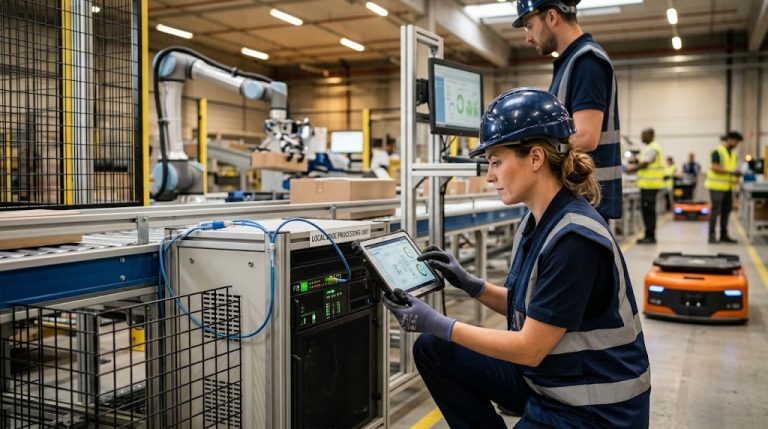
Major retail chains, supermarket networks, and distribution hubs are deploying rack-scale micro-datacenters inside backrooms and loading bays. These units power real-time inventory tracking, cashier-less automated checkout systems, dynamic pricing engines, and localized anti-theft video analytics without exposing store operations to network outages.
Healthcare Campuses
Modern hospitals generate massive diagnostic datasets from MRI scanners, CT systems, and continuous patient monitoring equipment. Deploying micro-datacenters on hospital grounds allows medical staff to run high-resolution AI diagnostic models locally while ensuring strict patient data privacy compliance by keeping sensitive medical records physically on-site.
Smart Cities and Municipal Infrastructure
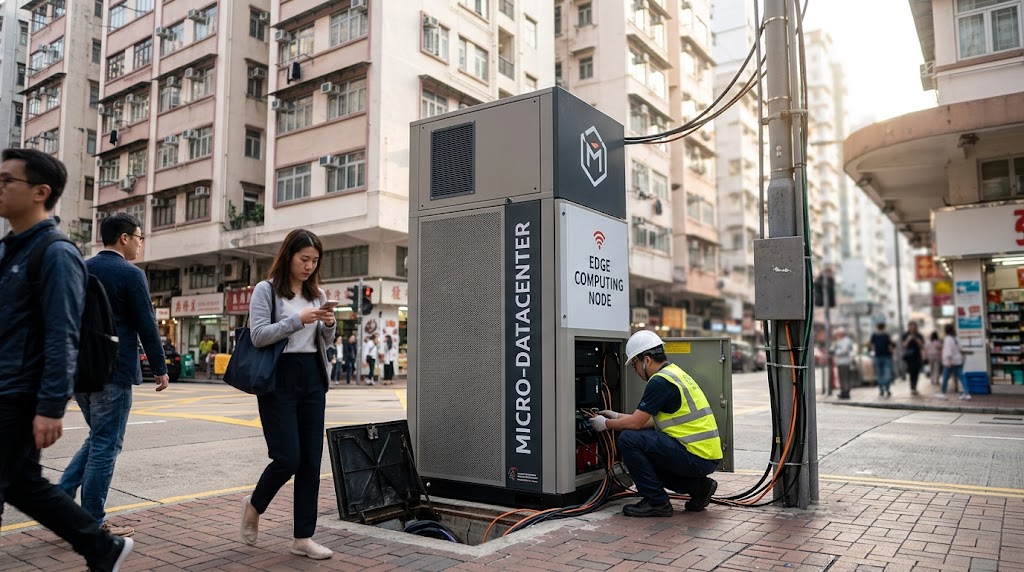
Municipalities are integrating micro-datacenters into public utility stations, traffic management centers, and EV charging hubs. These localized nodes orchestrate smart grid energy distribution, real-time traffic light optimization based on live camera feeds, and automated emergency service routing.
Operational and Economic Advantages
For enterprises and infrastructure providers, the migration toward decentralized micro-datacenters offers compelling business fundamentals.
- Rapid Time-to-Market: Traditional data center construction requires extensive civil engineering, custom site work, and lengthy utility negotiations. Micro-datacenters are pre-engineered in controlled factory environments, allowing organizations to scale computing footprint in weeks rather than years.
- Capital Expenditure Efficiency: Modular architecture allows companies to adopt a “pay-as-you-grow” strategy. Instead of building massive over-provisioned facilities to account for future decade-long growth, organizations can deploy additional micro-datacenter modules incrementally as local demand requires.
- Fault Isolation and Disaster Resilience: In a centralized cloud architecture, a major facility outage or severed fiber trunk can disrupt service across entire geographic regions. Distributed micro-datacenter networks isolate operational risks. If one edge node experiences a mechanical hardware failure or local power loss, workloads automatically failover to neighboring micro-nodes without interrupting the wider network.
Technical and Logistical Challenges
Despite their rapid growth, deploying thousands of miniature data centers across decentralized physical locations presents distinct operational hurdles.
Power Availability and Site Constraints
While a micro-datacenter is far smaller than a traditional facility, modern high-density compute gear running AI workloads still requires significant electrical power and physical space. Securing reliable multi-kilowatt power connections in crowded urban environments, historic retail zones, or remote roadside locations can involve complex utility approvals and costly grid connection upgrades.
Unmanned Maintenance and Physical Security
Hyperscale data centers are guarded by security personnel, biometric checkpoints, and on-site engineering staff 24 hours a day. Micro-datacenters, by contrast, are almost entirely unmanned and physically accessible in public or semi-public spaces. Infrastructure providers must rely on hardened steel housings, remote environmental sensors, physical tamper alarms, and automated self-healing software to maintain operational integrity.
Regulatory Fragmentation and Permitting
Building a single massive data center requires navigating zoning regulations with a single local authority. Deploying a network of hundreds of micro-datacenters across multiple municipalities, counties, and states forces operators to handle a complex patch of local building codes, noise ordinances, fire safety certifications, and environmental planning approvals.
The Hybrid Future: A Multi-Tiered Compute Ecosystem
The rise of micro-datacenters does not signal the death of the central cloud. Instead, it marks the maturation of a multi-tiered, hierarchical compute topology.
In this evolving digital ecosystem, computing tasks are assigned dynamically based on latency, data volume, and processing requirements:
- The Edge Tier (Micro-Datacenters): Manages sub-millisecond real-time actions, local AI inference, initial data filtering, and continuous sensor processing directly at the point of creation.
- The Metro Tier (Regional Data Centers): Acts as intermediate regional aggregation hubs, managing city-wide data caching, localized application hosting, and secondary analytics.
- The Core Tier (Hyperscale Cloud): Handles heavy macro-level processing, long-term archival storage, deep multi-billion parameter AI model training, and global corporate database synchronization.
As digital services become more deeply woven into the physical fabric of daily life, the invisible distance between human action and digital processing is shrinking. The modern internet is no longer just a collection of distant server farms connected to glass screens; it is becoming a dense, ambient web of localized compute nodes humming quietly in our neighborhoods, street corners, and workplaces.