






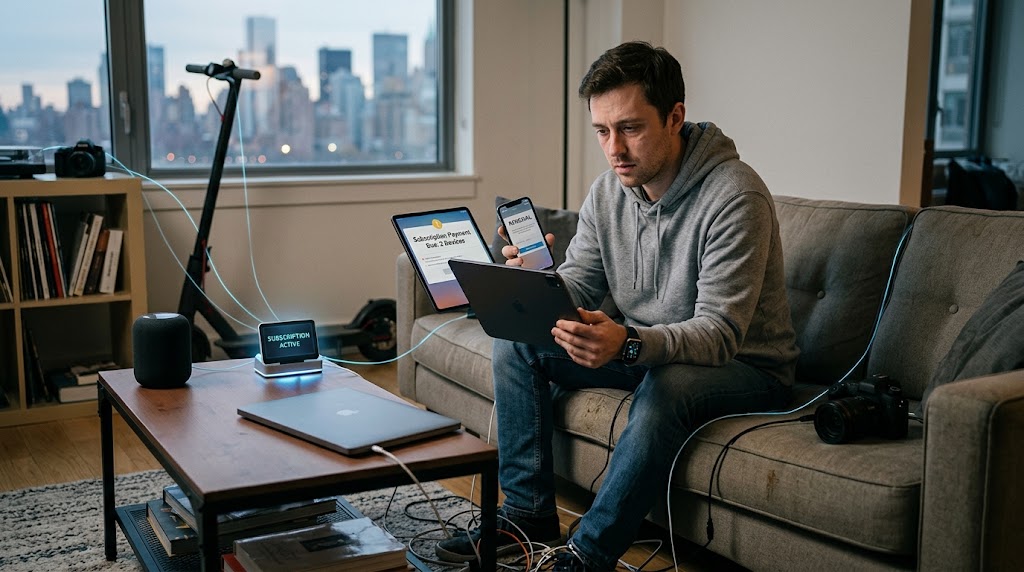
For generations, the implicit social contract of consumer commerce was straightforward: you paid for a physical product, took it home, and owned it outright. Whether it was a motor vehicle, a home appliance, a camera, or a desktop computer, the transaction ended at the cash register. The device was yours to use, modify, repair, or resell for as long as its physical components endured.
In 2026, that foundational concept of physical property ownership is rapidly dissolving.
Across the technology landscape, physical hardware is being systematically decoupled from functional utility. Consumer electronics, smart home appliances, personal wearables, and connected automobiles are increasingly shipped with fully functional physical components that remain dormant, restricted, or entirely disabled until the owner agrees to pay a recurring monthly or annual fee. What began as an enterprise IT procurement strategy—Hardware-as-a-Service (HaaS)—has bled into everyday consumer life, transforming permanent purchases into perpetual rents.
Consumers are discovering that buying a device no longer guarantees the right to use it. As software locks are placed on physical atoms, the tech industry is attempting a fundamental economic transition: turning one-time hardware sales into predictable, high-margin recurring revenue streams. In doing so, it has ignited a fierce global debate over property rights, consumer friction, and the true meaning of device ownership in a software-defined world.
The Business Engine: Wall Street’s Obsession with Recurring Revenue
To understand why hardware makers are eager to lock physical features behind software paywalls, one must look at the financial pressures governing modern technology corporations.
For decades, hardware manufacturing was an unforgiving, highly cyclical business. It required vast capital investment in factories, silicon foundries, supply chain logistics, and retail distribution. A company earned a margin on the initial sale, after which the customer might not spend another dollar for three, five, or seven years. Worse still for manufacturers, as hardware performance matured and replacement cycles lengthened, convincing consumers to upgrade to new models became progressively harder.
Software companies, by contrast, enjoyed the envy of Wall Street. The pivot to Software-as-a-Service (SaaS) over the past decade demonstrated that recurring subscription revenue yielded far higher valuations, predictable cash flows, and greater customer lifetime value.
It was inevitable that hardware executives would seek to copy the SaaS playbook. The global Hardware-as-a-Service market has ballooned into an industry valued well over $150 billion in 2026, expanding at a compound annual growth rate exceeding 20 percent.
In the corporate enterprise market, this shift often makes operational sense. For businesses, shifting hardware procurement from capital expenditure (CapEx) to operational expenditure (OpEx) preserves liquidity, simplifies tax structures, and guarantees automated hardware refreshes every few years. IT departments receive bundled provisioning, security patch management, and automated device recycling without bearing the risk of asset depreciation.
When transferred to the consumer market, however, the financial logic breaks down. Rather than offering true leasing options where the manufacturer retains responsibility for the physical asset, consumer tech brands are increasingly charging buyers the full retail price for physical hardware upfront—and then demanding a recurring toll to unlock the capabilities built directly into the device.
Gating Physical Atoms: The Architecture of the Micro-Paywall
The mechanisms used to gate physical hardware features rely on software entitlement managers connected to central cloud servers. Modern microprocessors, sensor suites, and electric motors are installed at the factory across all production units to streamline manufacturing lines. Whether those physical parts actually function is dictated entirely by remote digital keys.
This practice has infected virtually every category of modern hardware:
- Automotive Features: Carmakers pioneered some of the most aggressive hardware paywalls. EV manufacturers routinely install high-capacity battery packs into vehicles, only to software-limit available driving range unless the buyer pays thousands of dollars extra or subscribes to a monthly range extension. Other brands have attempted to put performance acceleration, rear-wheel steering angles, adaptive suspension tuning, and even physical heated seats behind recurring monthly charges.
- Biometric Wearables: Health tracking devices now ship with sophisticated optical sensors, electrocardiogram channels, and skin temperature monitors. However, several market leaders refuse to display detailed health metrics, sleep analysis, or stress scores to the user unless they maintain an ongoing monthly membership. Without the subscription, the expensive sensor array strapped to the user’s wrist or finger becomes virtually useless.
- Smart Home Infrastructure: Security cameras, video doorbells, and smart thermostats frequently restrict basic functionality—such as local video recording, person detection, or home automation integrations—behind cloud subscription tiers. When the subscription lapse occurs, hardware that cost hundreds of dollars drops back to primitive operational states.
- Computer Peripherals: Tech companies have even experimented with “forever hardware” concepts, floating ideas for computer mice, keyboards, and smart home hubs where physical device operation requires an active software maintenance tier to receive driver updates or maintain button customization.
Behavioral economists note that subscriptions succeed because they exploit human habit and reduce the immediate psychological “pain of paying”. When fees are small, automated, and invisible, consumers rarely re-evaluate whether they are receiving fair value. However, when that fee is attached to a physical object sitting on a desk or parked in a driveway, the psychological friction turns into active hostility.
The Consumer Backlash: “Paying Twice” for the Same Product
The core reason hardware subscriptions trigger such intense consumer backlash is that users perceive a fundamental difference between cloud services and local physical hardware.
When a consumer pays a monthly fee for cloud storage, streaming media, or real-time road navigation data, they accept that the vendor incurs continuous server costs, bandwidth consumption, and maintenance overhead to deliver that service. A subscription feels justified because the company is providing ongoing operational output.
When a company demands a monthly fee to activate a heated seat, unlock extra battery capacity, or view data from a local heart-rate sensor, no ongoing cloud infrastructure is required. The heating coils are already installed in the cushion; the battery cells are already mounted under the floorboards; the sensor is already shining light into the user’s skin.
To the consumer, paying a subscription for local hardware execution feels like paying twice: first to purchase the physical asset, and second to ransom features that are already physically present.
+--------------------------------------------------------------------------+
|                     THE VALUE VS. RESENTMENT MATRIX                      |
|                                                                          |
|  Cloud Services (SaaS)     ---> Remote Infrastructure  ---> High Acceptance|
|  Continuous Maintenance    ---> Ongoing Human Labor    ---> Moderate       |
|  Local Hardware Features   ---> On-Device Silicon      ---> High Resentment|
|  Software-Locked Atoms     ---> Factory Installed      ---> Severe Backlash|
+--------------------------------------------------------------------------+
This dynamic has bred severe subscription fatigue. Overwhelmed by dozens of recurring charges across software, media, and digital utilities, consumers are increasingly drawing a hard line at their physical possessions.
The pushback has forced several high-profile corporate retreats. Automotive giant BMW famously walked back its controversial attempt to charge a monthly fee for heated seats following global public ridicule and customer outrage. Similarly, smart home camera makers have faced severe public criticism when attempting to strip away previously free local storage options to force users onto monthly cloud plans.
In response to hardware paywalls, a growing subculture of technical workarounds has emerged. Vehicle owners have turned to open-source software modifications and aftermarket hardware bypasses—effectively “jailbreaking” their own cars and appliances to bypass digital rights management (DRM) locks and unlock features built into their hardware at the factory.
Legal, Regulatory, and Environmental Fallout
The shift toward hardware paywalls has pushed the concept of property ownership into uncharted legal and environmental territory.
1. The Death of the Secondary Market
Traditionally, physical devices retained resale value based on their physical condition and remaining operational life. Hardware-as-a-Service models destroy this market dynamic. If a used car or smart appliance requires a new owner to pay thousands of dollars in re-activation fees or take over high monthly subscriptions just to access basic features, the resale value collapses. Second-hand buyers are forced to evaluate used hardware not by its physical integrity, but by its ongoing software licensing terms.
2. Right-to-Repair and Ownership Legislation
Legislators across Europe and North America are stepping into the fray. The expanding “Right to Repair” movement, which originally focused on forcing tech companies to sell spare parts and repair manuals, has increasingly expanded its focus to software freedom.
Lawmakers in several jurisdictions are introducing bills aimed at banning software locks on factory-installed hardware components. Proposed legislation seeks to mandate that if a physical component is permanently installed in a product sold to a consumer, restricting its basic operation via software paywalls constitutes an unfair commercial practice.
3. The E-Waste Paradox
Corporate proponents of Hardware-as-a-Service often frame the model as a win for sustainability, arguing that leased equipment can be retrieved, refurbished, and recycled in controlled circular-economy loops.
In practice, software-gated hardware often produces the opposite outcome. When a hardware company shuts down its cloud authentication servers, goes bankrupt, or chooses to deprecate support for older models, perfectly functional physical devices instantly turn into electronic waste. Appliances, home hubs, and wearables that could physically operate for a decade are routinely rendered useless because the software permission key has been turned off remotely.
The Horizon: Re-Establishing Boundaries in Consumer Tech
The conflict between corporate desire for recurring revenue and consumer demand for genuine ownership has reached a strategic crossroad.
As subscription resistance hardens, a market bifurcation is taking shape:
On one side stand companies pushing the Hardware-as-a-Service paradigm to its logical extreme. These brands will likely abandon the pretense of selling hardware altogether, transitioning entirely to true lease-and-service models. Under this approach, consumers pay a single, transparent monthly fee that includes the device, continuous software updates, immediate hardware replacements when broken, and automatic upgrades every two years. While this eliminates traditional ownership, it offers clarity: the consumer knows they are renting a service, not buying a machine.
On the other side, an increasing number of consumer electronics brands are beginning to use “true ownership” as a primary competitive advantage. These companies market products explicitly highlighting localized processing, local storage options, zero recurring fees, and complete offline capability. For a growing demographic of subscription-weary buyers, paying a higher upfront price for a device that is completely theirs to keep has become a powerful purchasing incentive.
The subscription economy has transformed modern life, bringing flexibility and access to digital goods. But when applied indiscriminately to physical hardware, it threatens to reduce citizens from owners of property to permanent tenants in their own lives. The coming years will determine whether physical technology remains a set of personal tools under user control, or converts permanently into a network of micro-metered tollbooths.