







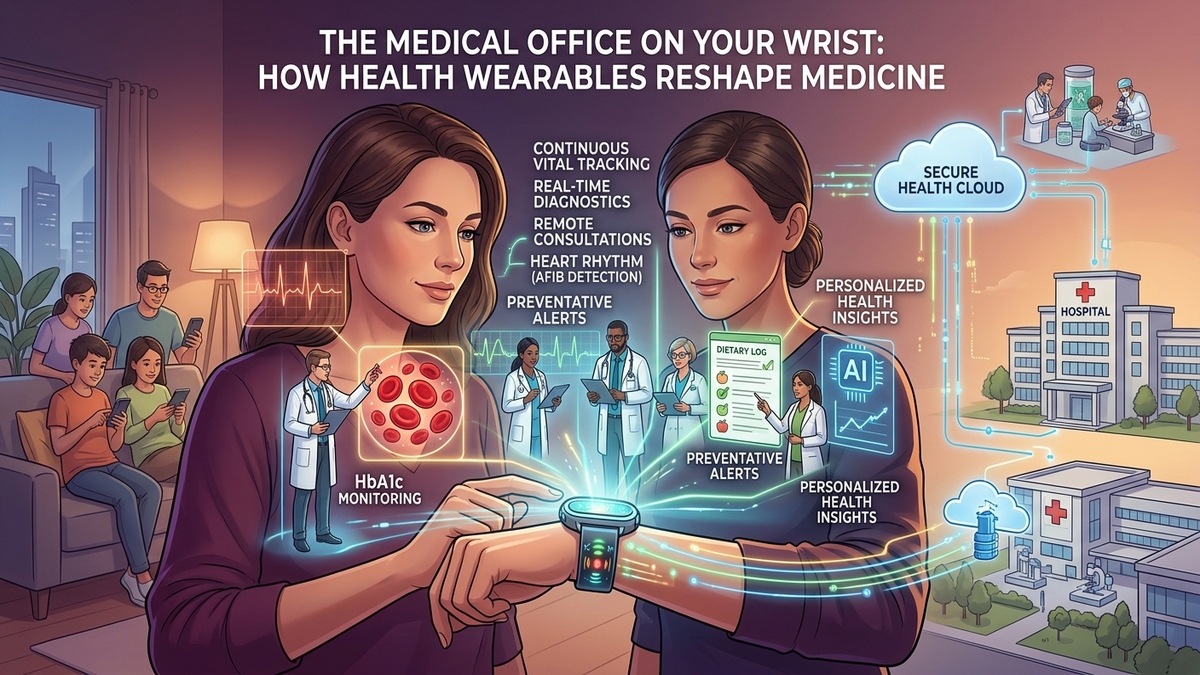
For decades, the standard paradigm of clinical medicine has rested on a fundamental structural constraint: episodic observation. A patient visited a clinic once or twice a year, sat on an examination table, and had their vital signs captured across a five-minute window. Blood pressure, heart rate, oxygen saturation, and cardiac rhythm were recorded as static snapshots—isolated data points assumed to represent months of complex, dynamic human biology.
That traditional architecture is collapsing. Over the past several years, a silent revolution in consumer micro-electronics, sensor miniaturization, and machine learning has turned wrist-worn devices into continuous, clinical-grade health monitors. What began as fitness step counters and calorie estimators has matured into a sophisticated diagnostic infrastructure operating directly on the human body.
Today, smartwatches and bio-sensing wrist wearables are detecting silent cardiac arrhythmias, screening for sleep apnea, tracking motor symptoms in Parkinson’s disease, and alerting care teams to early signs of metabolic and respiratory deterioration before symptoms trigger an emergency room visit.By shifting health tracking from episodic hospital visits to continuous ambient monitoring, health wearables are quietly dismantling the traditional boundaries of clinical practice, altering the economics of chronic disease management, and forcing healthcare systems to rethink what it means to diagnose and treat disease.
The End of Episodic Medicine: From Snapshots to Continuous Triage
The core limitation of traditional diagnostic medicine has always been time. Paroxysmal atrial fibrillation—a fleeting, irregular heart rhythm that dramatically increases the risk of stroke—frequently evades detection during brief in-office electrocardiograms (ECGs). Similarly, nocturnal respiratory disruptions, transient hypertension, and subtle motor tremors often manifest far away from a doctor’s office.
Wrist-worn health monitors bridge this gap by establishing continuous physiological baselines. Utilizing high-frequency photoplethysmography (PPG) optical sensors, bio-impedance arrays, and miniaturized single-lead ECG electrodes, modern wearables analyze micro-changes in blood volume, pulse transit time, and electrical heart activity thousands of times a day.
Continuous Photoplethysmography (PPG) & ECG Sensors
        ↓
On-Device Machine Learning & Algorithmic Screening
        ↓
Longitudinal Baseline Modeling & Anomaly Detection
        ↓
Automated Clinical Triage & Remote Provider Alerting
This continuous telemetry transforms healthcare from reactive intervention into predictive triage. Rather than waiting for a patient to experience severe chest discomfort or acute fatigue, algorithms running on the wrist detect micro-deviations from an individual’s historical baseline. When an anomaly persists—such as elevated nocturnal heart rate combined with reduced heart rate variability (HRV)—the system flags the trend, offering clinicians an early warning window that was previously impossible without costly, short-term hospital admissions.
Clinical-Grade Validation and the Regulatory Shift
The transition of wearables from novelty consumer gadgets into recognized clinical instruments required an unprecedented alignment between technological capability and regulatory oversight. For years, medical professionals routinely dismissed patient-provided smartwatch data as unreliable noise.
That skepticism has dissolved as international regulatory bodies expanded formal clearances for wearable algorithms and biosensors.The U.S. Food and Drug Administration (FDA) has authorized over 1,300 AI-enabled medical devices, a growing share of which are incorporated into or linked with consumer wearables.
Regulatory clearance has transformed wristwear across several core diagnostic categories:
- Cardiovascular Monitoring: FDA-cleared single-lead ECG applications and passive photoplethysmography algorithms run continuously in the background to detect irregular heart rhythms indicative of atrial fibrillation.
- Sleep and Respiratory Screening: Specialized wrist sensors track blood oxygen desaturation patterns and movement micro-arousals during sleep, allowing non-invasive screening for obstructive sleep apnea without forcing patients into overnight clinical sleep laboratories.
- Neurological and Movement Tracking:Specialized algorithms monitor motor fluctuations, dyskinesia, and tremors in patients living with Parkinson’s disease, offering neurologists objective daily symptom profiles to optimize medication dosing.
- Cuffless Blood Pressure Estimation:Advanced pulse wave analysis models offer continuous, cuffless estimations of blood pressure trends, helping identify nocturnal hypertension—a major risk factor for heart failure that traditional arm-cuff readings frequently miss.
Concurrently, updated regulatory frameworks—such as the FDA’s Quality Management System Regulation (QMSR) incorporating international ISO 13485 standards—have forced device manufacturers to enforce rigorous software lifecycle management, cybersecurity protections, and clinical validation protocols. The result is a new class of “enhanced wellness” and medical-grade hybrid wearables that meet strict clinical efficacy standards while remaining comfortable enough for daily wear.
Revolutionizing Chronic Disease and Remote Patient Care
The economic and operational pressure on global health infrastructure is driven overwhelmingly by chronic disease management. Conditions such as diabetes, hypertension, chronic kidney disease, and heart failure require constant oversight, yet traditional healthcare delivery relies on periodic clinic visits that often fail to prevent acute decompensation.
Wrist-worn devices are becoming the operational hub of Remote Patient Monitoring (RPM) and “Hospital-at-Home” delivery models. By coupling wrist monitors with continuous glucose monitors (CGMs) and home health hubs, care teams maintain real-time visibility into high-risk patient populations.
| Clinical Metric | Traditional Primary Care Model | Wearable-Integrated Remote Care Model |
| Data Collection | Episodic (1–2 clinical visits per year). | Continuous, longitudinal passive telemetry 24/7. |
| Arrhythmia Detection | Dependent on symptomatic timing during brief ECGs. | Passive background pulse checks with automated notification. |
| Hypertension Management | Periodic arm-cuff measurements subject to “white-coat” distortion. | Continuous cuffless trend modeling across sleeping and waking hours. |
| Intervention Trigger | Acute patient distress or routine scheduled follow-up. | Automated risk scoring triggering proactive outreach by care coordinators. |
| Hospital Readmissions | High risk due to unmonitored post-discharge deterioration. | Reduced through automated vital sign anomaly tracking. |
In heart failure management, subtle changes in wrist-measured skin temperature, physical activity levels, resting heart rate, and respiratory rates often precede clinical fluid overload by several days. Automated monitoring platforms analyze these metrics in real time, prompting care coordinators to adjust diuretic medications remotely. This proactive loop prevents emergency hospitalizations, reduces emergency room overcrowding, and lowers overall care delivery costs.
The Physician’s Dilemma: Alert Fatigue, Liability, and Workflow Integration
Despite the clear clinical benefits of continuous health monitoring, the widespread adoption of medical wearables has introduced acute friction inside medical practices. Chief among these challenges is the threat of data overload and “alert fatigue”.
Primary care physicians and cardiologists are being flooded with uncurated consumer health data. When millions of patients receive automated notifications about minor, benign heart rate spikes or brief oxygen dips, thousands of anxious individuals flood clinics demanding immediate secondary diagnostic testing. Without specialized filtering architectures, this influx risks overwhelming primary care capacity and generating unnecessary, costly downstream diagnostic workups.
Furthermore, the legal liability framework surrounding wearable data remains deeply ambiguous. If a smartwatch records a transient cardiac irregularity or a subtle physiological anomaly, who is legally responsible for reviewing that data? If an automated system flags a potential issue on a Sunday evening and a physician does not review the cloud portal until Tuesday, does that delay constitute clinical negligence?
To resolve these operational hurdles, health systems are deploying specialized AI middleware and algorithmic triage platforms. These software layers interface between consumer wearable databases and hospital Electronic Health Record (EHR) systems:
- Data Normalization:Synthesizing raw streams from disparate smartwatch brands and biometrics into standardized clinical metrics.
- Algorithmic Filtering: Suppressing clinical noise and transient artifacts to isolate true, actionable physiological anomalies.
- EHR Summarization: Ingesting multi-month health trends and translating millions of data points into a single, digestible summary page within the physician’s existing workflow.
- Prioritized Routing: Automatically directing high-urgency alerts directly to specialized remote nursing hubs while filing low-risk trends into routine chart reviews.
By establishing clear clinical triage pipelines, healthcare systems can leverage wearable telemetry without burdening frontline physicians with unmanageable administrative noise.
Privacy, Data Monetization, and the Equity Gap
The proliferation of wrist-worn medical sensors raises critical ethical questions regarding data ownership, personal privacy, and equitable access to care.
Unlike traditional medical records stored behind firewalls in compliance with strict national healthcare privacy laws, health data generated by consumer wearables often falls into regulatory gray zones. Many wearable manufacturers reserve the right within end-user license agreements to anonymize, aggregate, and monetize user biometric streams, sharing sensitive health indicators with third-party data brokers, commercial advertisers, and pharmaceutical researchers.
As wrist-worn sensors capture increasingly intimate physiological signals—including continuous stress responses, circadian rhythm disruptions, and potential early indicators of cognitive decline—protecting users against unauthorized commercial profiling or insurance underwriting discrimination becomes a major policy priority.
Concurrently, the medical wearable revolution risks exacerbating existing health disparities. Clinical-grade smartwatches and high-end bio-sensing rings remain expensive consumer items, predominantly purchased by affluent, tech-savvy demographics who already possess good healthcare access. Low-income populations, uninsured individuals, and rural communities—who suffer disproportionately from chronic cardiovascular and metabolic diseases—face financial and infrastructure barriers to accessing these life-saving monitoring tools.
To close this digital health divide, progressive public health agencies and forward-thinking insurance providers have begun subsidizing medical-grade wrist wearables for high-risk chronic disease populations, recognizing that the cost of a subsidized smart monitor is vastly lower than the expense of a single avoided ICU admission.
The Future of Distributed Medicine
The evolution of the medical office on your wrist represents a permanent structural shift in human healthcare. As sensor precision improves and non-invasive optical sensing technologies mature—moving closer to non-invasive continuous glucose trend analysis and advanced vascular stiffness tracking—the diagnostic capabilities packed into a device weighing less than fifty grams will equal or surpass the diagnostic tools of a twentieth-century emergency room.
The ultimate goal of this technology is not to replace human physicians, but to fundamentally liberate them from the limitations of episodic observation. By surrounding individuals with continuous, intelligent, and unobtrusive diagnostic safeguards, medicine is shifting its center of gravity away from reactive hospital wards and directly onto the wrists of informed, empowered citizens.
In this new era of distributed, data-driven healthcare, the most important medical office in the world is no longer located inside a hospital building—it is worn wherever we go.